Clear information, comprehensive cover and an easy purchasing process.

Travel Insurance for trekking up to 6,500m
Trek with confidence! Our travel insurance covers trekking up to 6,500m, including medical needs and more. Quick & easy.
Customer reviews
Shared on Trustpilot
The insurance and payment process was smooth, straightforward and efficient.
The team quickly corrected my Antarctica cover and handled the replacement policy and refund.
I received all the information I needed to select the right policy, and the response was quick.
The team answered my questions and helped me make sure I had suitable cover for my trip.
Booking was simple, selecting the right package was easy, and everything felt efficient.
My questions were answered clearly and efficiently, and the purchase process was easy.
The high-altitude rescue cover was straightforward and included more protection than I expected.
Booking was simple, and the team quickly corrected my travel dates with clear communication.
When regional issues forced us to move our trip, the team changed our policy dates with plenty of support.
Clear terms, competitive pricing and suitable cover for a trekking trip in Nepal.
Finding suitable insurance for our high-altitude hikes in Peru was clear and easy.
Up to 6,500m
Trekking & select climbs
Helicopter
Approved evacuation
24/7
Emergency assistance
Is this cover right for my trek?
Rise & Shield offers high-altitude trekking cover for eligible routes around the world, with altitude options available up to 6,500m. Your trek must stay within the altitude level shown in your policy and meet any applicable route, guide and activity conditions.
Some popular treks that are covered are shown below.
Everest Base Camp
Mount Kilimanjaro
Annapurna Circuit
Manaslu Circuit
Mera Peak
Island Peak
Lobuche East
Cotopaxi
Mont Blanc — Goûter Route
Mount Kenya — Point Lenana
This is not a complete list and includes both high-altitude trekking routes and selected mountaineering peaks. Adventure Extreme covers eligible trekking and selected climbs up to 6,500m. Mountaineering cover is limited to specific named peaks and routes, with additional conditions applying. Terms, limits, exclusions and excesses apply.
What can our high-altitude trekking travel insurance cover?
Depending on your chosen plan, Rise & Shield can provide cover for some of the most important risks surrounding trekking at high altitudes.
What's not included in this policy?
Our high-altitude trekking cover does not extend to:
Altitudes above 6,500m or any trekking higher than the Adventure Extreme limit are out.
Solo, unguided or off-route expeditions that wander away from recognised trails.
Helicopter rescues without prior authorisation (and the separate excess unpaid).
What cover do I need for my trek?
Search for a trek, trail or mountain and we’ll show the activity level you’re likely to need.
Type at least two characters, then choose a suggestion.
What cover do I need for my trek?
Search for a trek, trail or mountain and we’ll show the activity level you’re likely to need.
Type at least two characters, then choose a suggestion.
Why choose Rise & Shield for trekking insurance?
Trekking can take you far beyond the risks of an ordinary holiday, from remote routes and changing weather to altitude and emergency evacuation.
Rise & Shield specialises in insurance for adventurous travel, with 24/7 emergency assistance, trusted relationships across the adventure travel industry, and the reassurance of an FCA-regulated insurance provider whose programme is reinsured at Lloydâs of London.
Rise & Shield is trusted by reputable tour operators and adventure companies









Why do I need high-altitude trekking insurance?
Ordinary travel insurance may exclude trekking at higher altitudes or activities involving remote mountain routes, evacuation and specialist climbing equipment.
Rise & Shield's Adventure Extreme add-on can cover eligible high-altitude trekking and selected mountaineering activities up to 6,500m, subject to the policy conditions.
What does Adventure Extreme cover?
Adventure Extreme extends eligible hiking and trekking cover up to 6,500m. It can also cover mountaineering up to 6,500m on selected named peaks and routes, subject to additional technical conditions.
Important: Add Adventure Extreme and make sure it appears in your policy summary before buying. Adventure Extreme is not available if you are 65 or older.
Does high-altitude travel insurance cover altitude sickness?
Eligible emergency medical treatment for altitude illness may be covered when Adventure Extreme is included and your activity meets the applicable altitude, route and guide conditions.
Cover remains subject to the policy terms, benefit limits, exclusions and applicable medical provisions.
Is helicopter evacuation covered at high altitude?
An eligible helicopter evacuation may be covered when it is medically necessary and approved by the 24/7 Emergency Assistance Centre.
The appropriate evacuation method depends on your location and circumstances, and a separate helicopter evacuation excess applies.
What if my high-altitude trip is cancelled or delayed?
Cover may help with eligible, unrecoverable costs if an insured event forces you to cancel your trip, return home early or disrupts your travel plans.
Cancellation, curtailment, travel-delay and missed-departure benefits remain subject to their individual limits, waiting periods and policy conditions.
Do I need a guide for trekking up to 6,500m?
Yes. Adventure Extreme trekking must take place with a professional, qualified and licensed guide, instructor or operator and remain on recognised routes or trails.
The same guide and recognised-route requirements apply to eligible mountaineering under Adventure Extreme, together with additional safety and peak-specific conditions.
Does this cover trekking and mountaineering?
Yes, but they are treated differently. High-altitude trekking follows recognised routes without specialist climbing equipment, while activities using ropes, picks or other specialist climbing equipment are treated as mountaineering.
Adventure Extreme can cover selected named peaks such as Island Peak, Mera Peak, Lobuche East, Cotopaxi and Mont Blanc via the Goûter Route. Mountaineering is subject to additional route and technical-climbing restrictions.
How to buy high-altitude trek insurance with Rise & Shield
Getting a free quote with Rise & Shield is easy. Follow these simple steps to secure your trip:
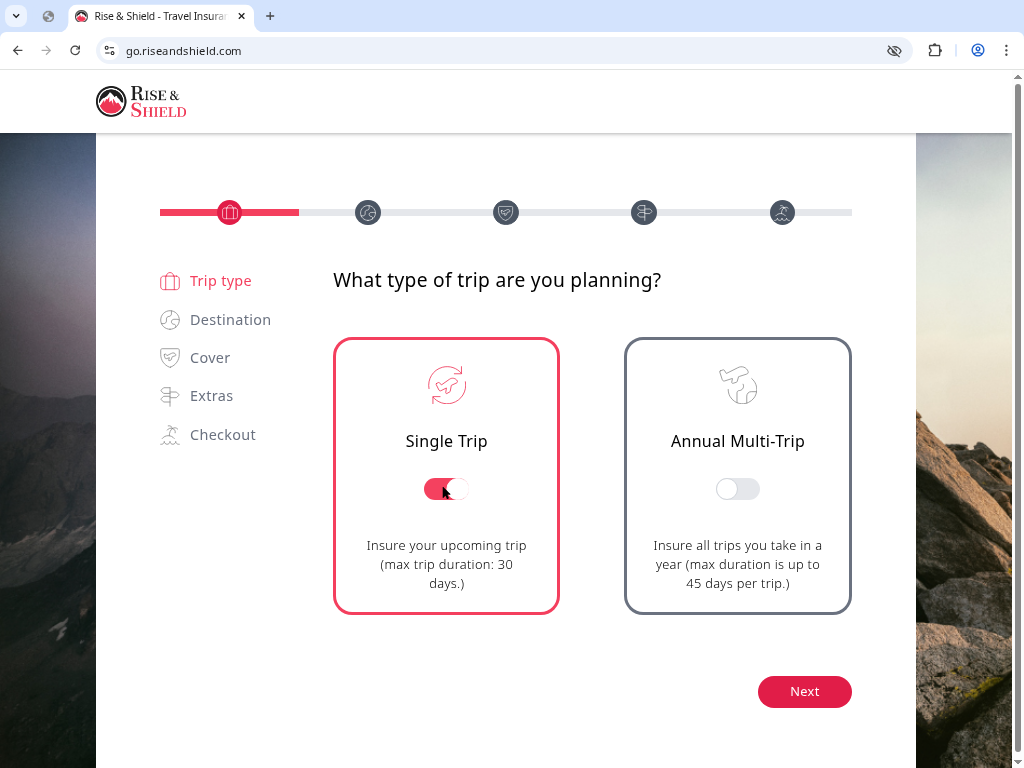
1. Start your quote
- Go to go.riseandshield.com
- On the first screen, under “What type of trip are you planning?”, select: Single Trip (for your specific EBC, Kili trek), Then click Next.
2. Add your trip details
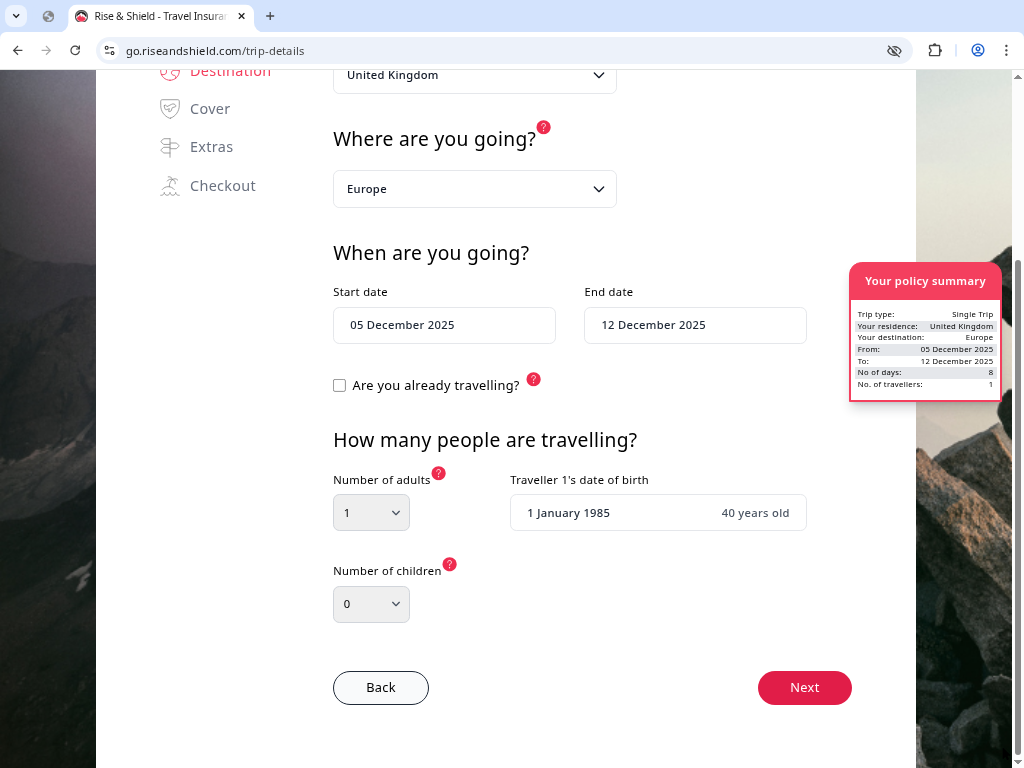
On the Destination step: Country of residency: Choose your usual country of residence from the drop-down (e.g. United Kingdom).
Where are you going?
Choose the region that matches your itinerary, for example:
- Worldwide (excluding North America)
The key is: pick the region that covers every country you’ll set foot in on the way to and from your trek.
When are you going?
Select your start date as the day you leave home, not just the day your trek starts.
Select your end date as the day you arrive back home.
This makes sure flights, hotel nights and delays around the trek are all covered.
How many people are travelling?
- Choose the number of adults and children.
- Enter each traveller’s date of birth when prompted.
Click Next to move on.
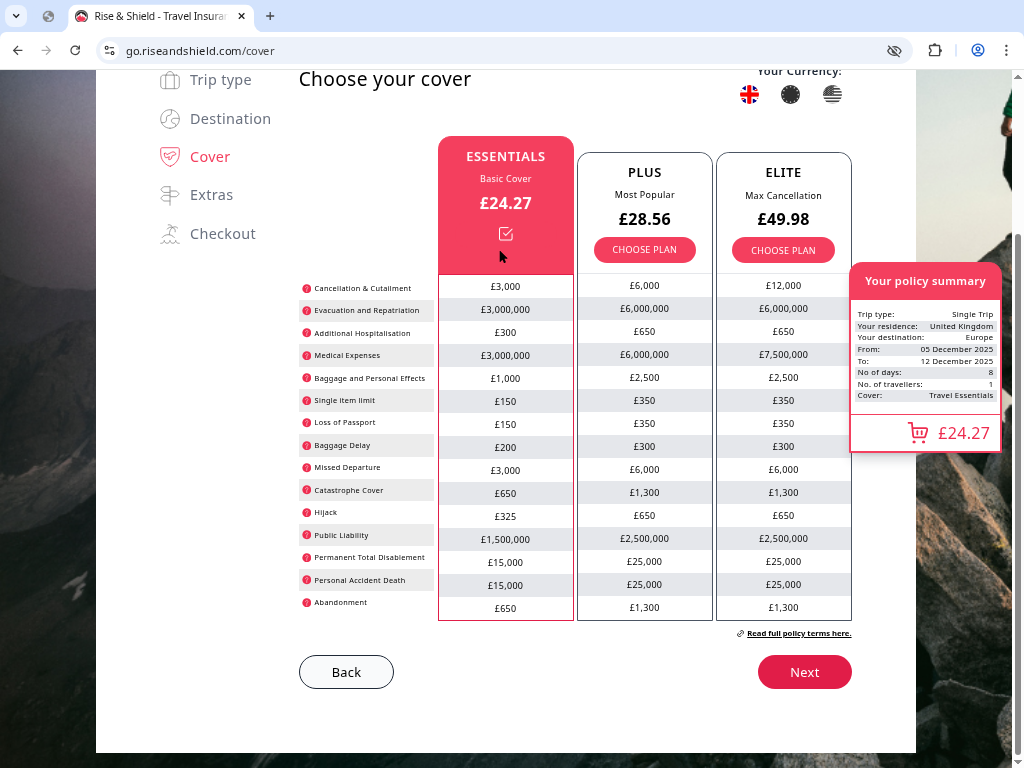
3. Choose your base cover (Essentials / Classic / Elite)
On the Cover step you’ll see three options:
- Essentials
- Classic
- Elite
Your ability to trek at altitude depends on the Adventure Extreme add-on, not which of these three you pick.
However, because high-altitude treks are remote and can be pricey, many trekkers go for Plus or Elite to get higher limits for:
- Emergency medical expenses
- Emergency evacuation and repatriation
- Trip cancellation/curtailment
Click the card for Essentials, Classic or Elite (whichever suits your budget and risk appetite).
Hit Next.
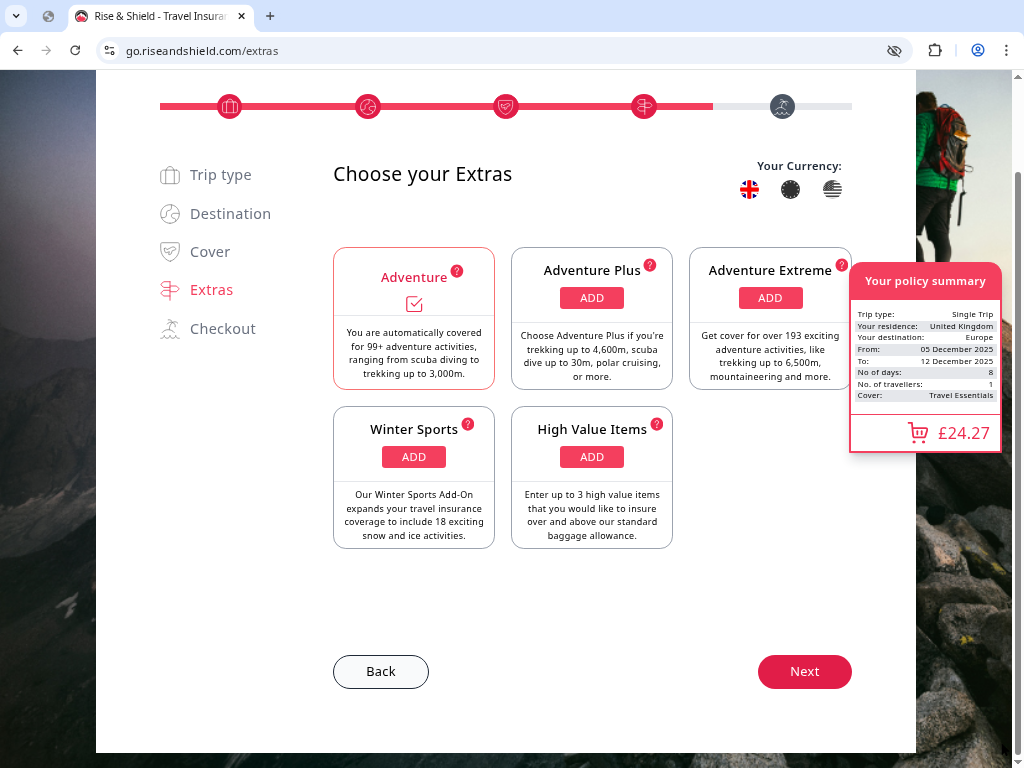
4. Add high-altitude trekking cover (Adventure Extreme add-on)
This is the crucial step for high-altitude trek trips.
On the Extras page you’ll see several tiles:
- Adventure: automatically included for a wide range of standard activities.
- Adventure Plus: for mid-level adventure (e.g. lower-altitude trekking, certain dives, etc.).
- Adventure Extreme: for high-altitude treks such as Kilimanjaro, Everest Base Camp and similar expeditions.
- Winter Sports, High Value Items, etc.
For high-altitude trekking like Kili or EBC you must:
- Find the Adventure Extreme tile.
- Click ADD on that tile.
- Check the policy summary box on the right:
The price updates.
Adventure Extreme appears under your cover/extras.
Remember: If Adventure Extreme is not listed, your high-altitude trek is not correctly covered, even if you’ve chosen a base policy.
Leave other extras (Winter Sports, High Value Items, etc.) off unless you specifically need them.
Click Next once Adventure Extreme is clearly shown in your summary.
5. Enter traveller, contact and address details
On the Checkout step:
Traveller details
- Enter your first name and surname exactly as they appear on your passport.
- Confirm your date of birth (auto-filled from earlier).
- Select your nationality from the drop-down.
Contact information
- Add an email address – this is where your policy documents are sent.
- Add a mobile number, including the country code if needed.
Address details
- Fill in your home address, town/city, postcode and confirm your country.
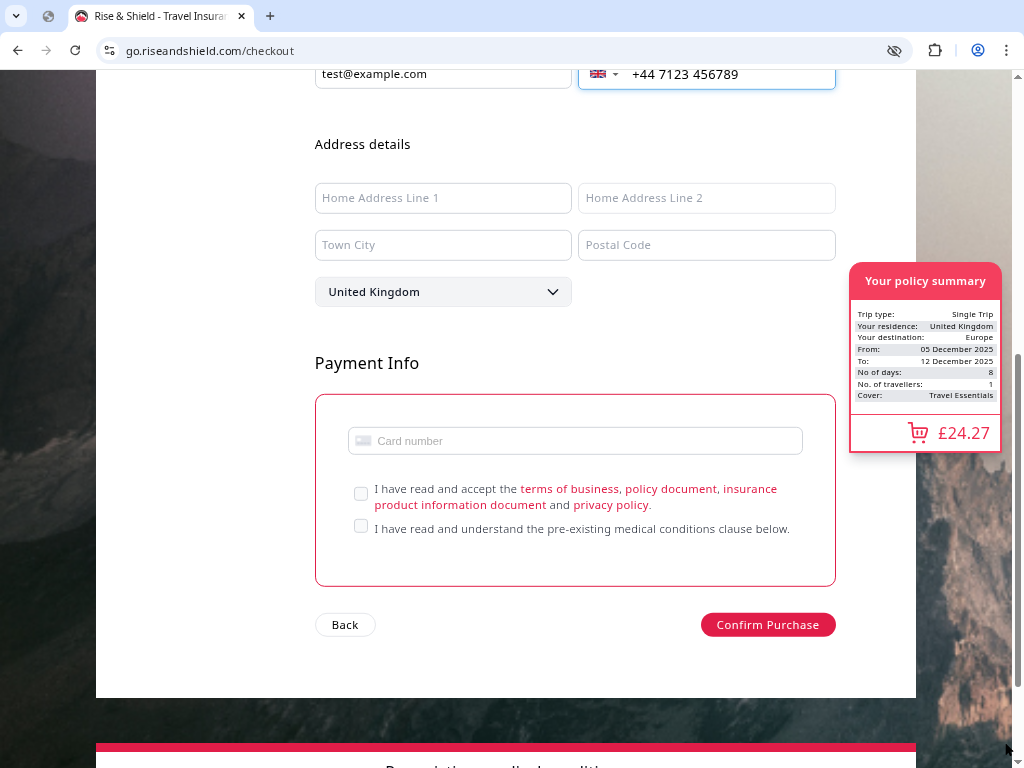
6. Payment & final checks
At the bottom of the Checkout page:
- Enter your card details securely.
- Tick the checkboxes to confirm.
- When you’re ready, click Confirm Purchase to complete the policy.
That’s the moment the policy is actually bought, so double-check:
- Dates are correct from leaving home to returning home.
- The destination region matches your full route.
- Adventure Extreme is still listed in your policy summary.
7. After you’ve bought the policy
Check your email for:
- Policy schedule (shows your dates, regions, add-ons like Adventure Extreme, and benefit limits).
- Full policy wording.
And then...
- Save a copy to your phone/tablet and/or print a copy to keep with your travel documents.
- Make a note of the emergency assistance number so you have it handy on the trek.
High-altitude trekking FAQs
Does travel insurance cover trekking up to 6,500m?
Yes, provided your policy specifically covers trekking at that altitude. Rise & Shield’s Adventure Extreme add-on can cover eligible hiking and trekking up to 6,500m, subject to the applicable guide, route and policy conditions.
What travel insurance do I need for trekking above 5,000m?
You need travel insurance with an altitude limit high enough for the highest point reached anywhere on your itinerary.
Rise & Shield’s standard cover includes eligible trekking up to 3,000m, Adventure Plus extends this to 4,600m, and Adventure Extreme extends eligible trekking to 6,500m.
What travel insurance do I need for trekking up to 6,000m?
For an eligible trek reaching 6,000m, you would need Adventure Extreme, because the route exceeds the 4,600m Adventure Plus limit.
Adventure Extreme provides eligible trekking cover up to 6,500m, so it can accommodate qualifying 6,000m itineraries within the policy conditions.
Do I need Adventure Extreme for trekking above 4,600m?
Yes. Adventure Plus only extends eligible trekking cover to 4,600m.
If your route climbs above that altitude, even briefly, Adventure Extreme is the relevant Rise & Shield add-on for eligible trekking up to 6,500m.
How do Rise & Shield’s trekking altitude levels work?
Rise & Shield currently has three trekking levels:
- Standard cover: eligible trekking up to 3,000m
- Adventure Plus: eligible trekking up to 4,600m
- Adventure Extreme: eligible trekking up to 6,500m
The cover level should be based on the highest altitude reached during your complete itinerary.
Does Rise & Shield cover Everest Base Camp?
Eligible Everest Base Camp trekking can be covered with Adventure Extreme, provided the route and guide conditions are met.
Everest Base Camp is specifically highlighted by Rise & Shield as one of the high-altitude treks suitable for its 6,500m trekking cover.
Does Rise & Shield cover Mount Kilimanjaro?
Yes. Eligible Kilimanjaro itineraries can be covered with Adventure Extreme, subject to the applicable conditions.
Kilimanjaro is also one of the specifically named peaks under Rise & Shield’s Adventure Extreme mountaineering rules, including the Western Breach.
Is the Western Breach on Kilimanjaro covered?
It can be. Kilimanjaro, including the Western Breach, appears on Rise & Shield’s current list of named peaks and routes that may be covered under Adventure Extreme mountaineering.
The climb must still meet the guide, recognised-route, safety and technical-climbing conditions.
Does high-altitude trekking insurance cover Island Peak?
Island Peak is one of the specifically named peaks that may be covered under Adventure Extreme mountaineering up to 6,500m.
Because Island Peak can involve ropes or specialist climbing equipment, it is treated differently from ordinary trekking and is subject to the mountaineering conditions.
Is Mera Peak covered by travel insurance?
Mera Peak is included on Rise & Shield’s current list of named peaks that may be eligible for Adventure Extreme mountaineering cover.
You must use a professional, qualified and licensed guide, remain on a recognised route, wear appropriate safety equipment and meet the applicable technical-climbing conditions.
Is Lobuche East covered?
Lobuche East is another specifically named peak that may be covered under Adventure Extreme.
The mountaineering conditions apply, including recognised routes, a professional guide and restrictions on technical climbing and exploratory or free-mountaineering activity.
Which mountaineering peaks can Adventure Extreme cover?
Rise & Shield’s current named-peak list includes Island Peak, Mera Peak, Stok Kangri, Mount Toubkal, Mount Kenya (Point Lenana only), Mount Kazbek, Mont Blanc via the Goûter Route, Monte Rosa, Cotopaxi, Illiniza Norte, Lobuche East and Kilimanjaro including the Western Breach.
Mountaineering outside the named peaks and routes should not be assumed to be covered.
What is the difference between high-altitude trekking and mountaineering?
Rise & Shield treats hiking and trekking as travel on recognised routes or trails without the specialist climbing equipment that turns the activity into mountaineering.
If ropes, picks or other specialist climbing equipment are required, the activity may be classified as mountaineering instead and must meet the separate Adventure Extreme mountaineering conditions.
Does Adventure Extreme cover technical climbing?
Only within defined limits.
Adventure Extreme excludes routes requiring free climbing or multi-pitch technical rock or ice climbing above UIAA Grade II or an equivalent grading system. Free mountaineering, exploratory expeditions and new routes are also excluded.
Is mountaineering above 6,500m covered?
No. High-altitude climbing above 6,500m is excluded from the Adventure Extreme mountaineering cover.
That means Everest summit attempts and other climbs exceeding the policy’s maximum altitude fall outside this cover.
Can I trek up to 6,500m without a guide?
No. Trekking under Adventure Extreme carries the condition that you must be with a professional, qualified and licensed guide, instructor or operator.
The activity must also remain on a recognised route or trail.
Are solo high-altitude treks covered?
Adventure Extreme trekking requires a professional, qualified and licensed guide and must take place on recognised routes or trails.
Unsupported, exploratory or off-route high-altitude expeditions should therefore not be assumed to be covered.
Does high-altitude trekking insurance cover altitude sickness?
Eligible emergency medical treatment for altitude illness may be covered when you have selected the correct high-altitude trekking cover and your activity meets the relevant policy conditions.
Rise & Shield’s current 6,500m trekking page specifically includes emergency medical cover for altitude sickness among the benefits of Adventure Extreme.
Is helicopter rescue covered while trekking above 5,000m?
An eligible helicopter evacuation may be covered when it is medically necessary and approved in advance by the Emergency Assistance Centre.
The exact rescue method depends on the circumstances, and a separate helicopter evacuation excess may apply.
Does high-altitude travel insurance cover cancellation and curtailment?
Your selected travel plan may provide cancellation and curtailment benefits for qualifying insured events, subject to the plan’s individual benefit limits and policy conditions.
Adventure Extreme changes the activities you are insured to undertake; the underlying travel benefits still depend on the base plan you select.
Is my trekking equipment covered?
Eligible baggage and personal belongings can be covered under the baggage section of your selected policy, subject to overall limits, individual-item limits, security requirements and applicable excesses.
Specialist equipment should always be checked against the limits of the plan you choose rather than assuming its full replacement value is insured.
Can I camp at high altitude with Adventure Extreme?
Rise & Shield currently lists camping up to 6,000m as an Adventure Extreme activity.
Camping must take place on established campsites, and participants must carry a satellite communication device or file an itinerary with local park authorities or wardens.
Is camping above 6,000m covered?
Do not assume so. Although Adventure Extreme trekking extends to 6,500m, Rise & Shield’s separate camping activity is currently listed only up to 6,000m.
If your itinerary involves sleeping above that altitude, check the itinerary with Rise & Shield before buying.
Can travellers aged 65 or over buy Adventure Extreme?
No. Rise & Shield’s current activities guidance states that Adventure Extreme is not available if you are 65 or older.
Travellers who do not need Adventure Extreme may still be eligible for other Rise & Shield cover, subject to the normal age and policy requirements.
Can one policy cover my high-altitude trek and the rest of my holiday?
Yes. Your Rise & Shield travel policy can cover the wider insured journey as well as eligible high-altitude trekking, provided the full trip dates and destinations are insured and Adventure Extreme is added for the activities that require it.
That means you do not normally need a separate policy purely for the trekking portion of your holiday.
Can I get high-altitude trekking insurance if I do not live in the UK?
Rise & Shield provides travel insurance to eligible international travellers, subject to its residence, destination and policy eligibility requirements.
Check your quote and policy documents for the rules that apply to your country of residence and complete itinerary.
When should I buy high-altitude trekking insurance?
It is generally sensible to arrange your insurance once the trip is booked so that any eligible pre-departure cancellation benefits in your chosen plan can begin.
Before buying, confirm your maximum altitude, route, guide arrangements and whether the itinerary is trekking or mountaineering, then make sure Adventure Extreme appears in the policy summary.
What if I do not know whether my trip counts as trekking or mountaineering?
Check whether your itinerary involves ropes, picks, crampons or other specialist climbing equipment.
If it does, do not rely solely on the trek or mountain name: check the activity classification and exact route before purchasing. Rise & Shield’s activity checker can help identify the required add-on and applicable conditions.
Can I get insurance for a 6,000m mountain?
Potentially, yes. Adventure Extreme can cover eligible trekking and selected mountaineering up to 6,500m.
For mountaineering, however, the mountain and route must fall within Rise & Shield’s named-peak rules and technical restrictions. Simply being below 6,500m does not automatically make every mountain covered.
Does the 6,500m limit mean I can climb any mountain below 6,500m?
No.
For trekking, the itinerary must meet the Adventure Extreme guide and recognised-route conditions. For mountaineering, cover is additionally restricted to the specified named peaks and routes and excludes free mountaineering, exploratory climbs and routes beyond the permitted technical grade.
You might also need
Popular activities
Popular destinations
©2026 Rise & Shield. All rights reserved.
Rise and Shield is a trading style of Optimum Global Limited, which is authorised and regulated by the Financial Conduct Authority. Optimum Global Limited’s Firm Reference Number is 453654, you can check these details at https://register.fca.org.uk or by calling the Financial Conduct Authority on 0800 111 6768. . Registered address: Optimum Global Limited, 4th Floor, 21 Perrymount Road, Haywards Heath, West Sussex, RH16 3TP, UK. Optimum Global Limited is registered in England and Wales. Company Registration number 05347793.