Why you need travel insurance for Norway
Everything About Travel Insurance

Norwegian Fjords Cruise Insurance: What You Actually Need

I still remember the moment I first saw a photo of the Norwegian fjords from a ship’s deck.

Steep green walls, waterfalls tumbling into still water, tiny villages tucked into the shoreline… and my brain went: I need to go there.

About five minutes later, my “daydream brain” was interrupted by my “Head of Operations brain”, which politely asked:

“Cool. But what happens if you break an ankle halfway up a fjord, or the ship has to divert and you miss your flight home?”

That’s where Norwegian fjords cruise insurance comes in.

In this guide, I’ll walk you through why fjords cruises are different from a normal city break, what good cruise insurance should cover, and how we handle it at Rise & Shield. 

All in plain English, no jargon, just the stuff you actually need to know.

Ready? Let’s roll.

Ready for unlimited adventure? Get travel insurance that covers over 150 activities and 190 destinations.

Why Norwegian fjords cruises need specific insurance

A Norwegian fjords cruise feels tame on the brochure: no icebergs smashing into the hull, no polar bears, just pretty villages and waterfalls.

But from an insurance point of view, fjords trips are still cruises in remote places, and that changes the risk profile.

Here’s why proper Norwegian fjords cruise insurance matters.

1. Many cruise lines expect proof of cruise cover

A lot of major cruise lines now require suitable travel insurance before they’ll let you board, especially for routes that go into more remote regions.

And yes, Norwegian fjords itineraries are often on that list. If you can’t show proof of cruise cover, you may be denied boarding at your own expense.

That’s not scare tactics; that’s just how the cruise industry operates now.

What your Norway travel insurance does in real life

2. You’re often far from big hospitals

Norwegian healthcare is excellent, but fjord towns and small ports aren’t exactly next door to major hospitals. If something serious happens on board or during a shore excursion, you might need:

  • Treatment in a local clinic or hospital
  • Transfer to a larger facility
  • Repatriation home if you can’t continue your trip

The UK government specifically recommends having appropriate travel insurance that can handle local treatment and medical evacuation in Norway.

As a type 1 diabetic, my personal rule is simple: if I’m going somewhere remote, I don’t leave home without solid medical cover.

3. Cruise itineraries are more fragile than city breaks

With a fjords cruise, everything is linked:

  • Flights to the embarkation port
  • The ship’s schedule and ports of call
  • Pre- and post-cruise hotels
  • Transfers and trains in between

If one domino falls (just think: severe weather, strikes, a mechanical issue), it can throw off the whole itinerary. 

Good fjords cruise insurance helps absorb those shocks: missed departure, delays, unused prepaid costs and so on.

Cover your trip today

Planning a trip to Norway? Get comprehensive travel insurance for medical needs, trip interruptions, and more with Rise & Shield. Quick & easy.

4. Shore excursions come with extra risk

Most fjords itineraries include things like:

  • RIB or Zodiac boat tours
  • Fjord kayaking
  • Short hikes or viewpoints
  • Scenic railways and coach trips

Even if you stick to fairly gentle excursions, you’re still outdoors, on water, and sometimes in cold, changeable weather.

If a slip, fall, or medical issue happens there, you want your insurance to be crystal clear about how those activities are covered.

Travel insurance for Norway FAQs

How Norwegian fjords cruise insurance typically works

You’ll see two broad approaches in the market:

  1. Standard travel insurance with a cruise add-on
  2. Specialist cruise policies

Either way, for Norwegian fjords cruise insurance, look out for these core elements.

Medical and repatriation cover

This is non-negotiable. You’ll want:

  • Emergency medical treatment on board or ashore
  • Hospital stays
  • Medical evacuation if needed
  • Repatriation back home if you can’t safely continue your trip

Schengen visa rules for some nationalities set €30,000 as a minimum emergency medical limit, and many experts recommend treating that as an absolute floor, not a target.

Ready for unlimited adventure? Get travel insurance that covers over 150 activities and 190 destinations.

Cruise-specific cancellation and disruption

Good cruise cover should help with:

  • Cancelling the trip before departure for a covered reason
  • Cutting the trip short due to illness or emergencies
  • Travel delay and missed departure
  • Extra costs to catch up with the cruise, where covered

Some specialist cruise policies also offer niche benefits like missed ports, missed pre-booked excursions or cabin confinement, features that only make sense on cruises.

Is Norway in Europe for travel insurance

Baggage and personal belongings

Your kit is doing a lot of travelling: airports, transfers, the ship, and excursions. Look for:

  • Baggage cover for loss, theft and damage
  • Reasonable single-item and valuables limits
  • Some cover for delayed baggage

Clear rules around cruises and activities

This is the bit people often skip (and regret later):

  • Does the policy explicitly cover cruises? (Some standard policies exclude them unless you add cruise cover.)
  • Are your planned excursions listed in the activities section or covered under a specific upgrade?
  • Are there rules about only taking part in organised, guided activities with licensed operators?

If your insurer won’t cover a RIB trip, kayak excursion or certain walks because they’re classed as “adventure activities”, that’s something you want to know before you’re on the gangway, not after.

Cover your trip today

Planning a trip to Norway? Get comprehensive travel insurance for medical needs, trip interruptions, and more with Rise & Shield. Quick & easy.

How Rise & Shield handles Norwegian fjords cruises

At Rise & Shield, fjords cruises sit right in the sweet spot between our Norway travel insurance and our Arctic cruise cover.

Here’s how it usually works when I’m helping someone (or planning my own fantasy itinerary):

1. Start with the core Norway cover

You begin with a standard travel insurance policy that covers Norway, the same core structure we use on our Norway destination page:

  • Emergency medical expenses
  • Evacuation and repatriation
  • Trip cancellation and curtailment
  • Baggage and personal belongings
  • Travel delays and missed departures
  • 24/7 emergency assistance

The exact limits depend on the level of cover you choose, but the idea is simple: if something serious happens on your Norwegian trip, you’re not facing the bills alone.

Ready for unlimited adventure? Get travel insurance that covers over 150 activities and 190 destinations.

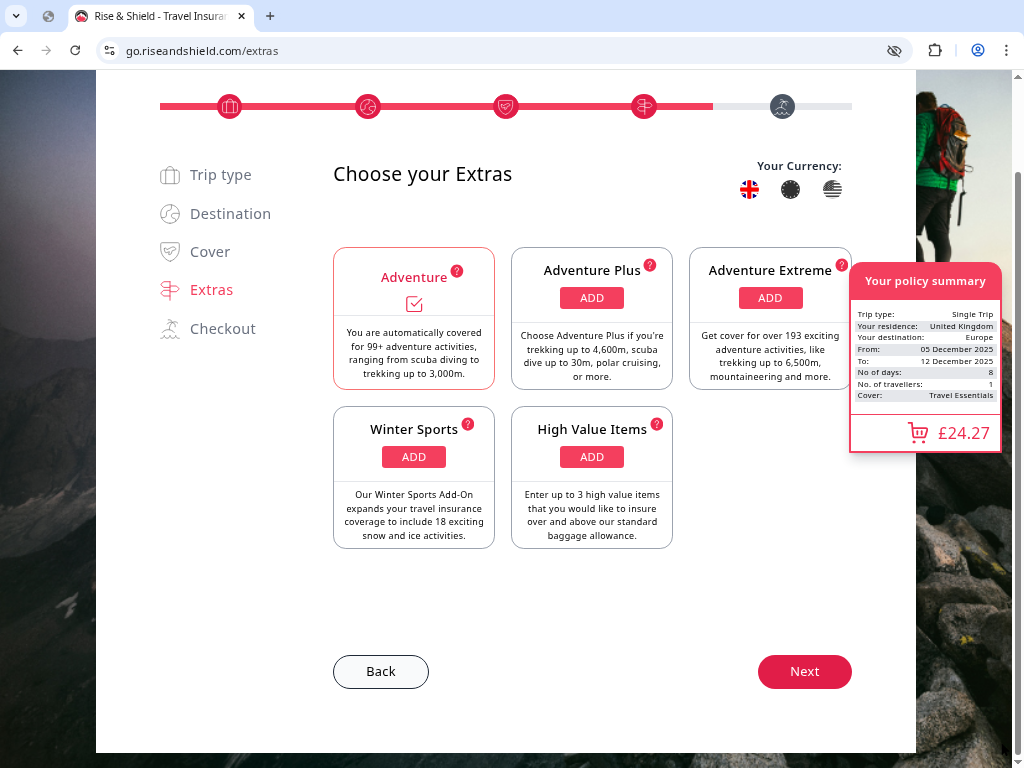
2. Add Adventure Plus for fjords cruises and excursions

If your itinerary includes a fjords cruise or coastal voyage, we generally expect you to add our Adventure Plus upgrade. That’s the part built for:

  • Norwegian fjords cruises and small-ship coastal trips
  • Organised excursions like fjord kayaking, Zodiac-style boat tours and certain guided hikes
  • Other adventure-leaning activities that are listed in your policy wording

We already use a similar combo – Travel Elite + Adventure Plus – for Arctic cruises and polar expeditions, where we cover things like organised kayaking, snowshoeing and camping as part of an official itinerary.

My pro tip: You can learn more in my deep dive into polar cruise insurance.

For fjords cruises, the principle is the same:

If it’s on the ship’s or tour operator’s activity list, and it appears in our activities section or Adventure Plus wording, we’re usually in good shape.

(Usual disclaimer: policies do have limits and conditions. Always double-check your specific activities against the policy wording before you hit “Book now”.)

Choosing the right level of cover for your Norway trip

What we don’t cover

There are a few things we can’t cover on fjords cruises, and it’s better to be upfront:

  • Independent or unorganised extreme adventures outside of recognised operators
  • Activities that aren’t listed or are clearly excluded in the policy wording
  • Trips where there’s no qualified medical support on board. For more extreme regions, we insist on an onboard doctor and treatment room. That’s standard for reputable expedition ships anyway.
  • Pre-existing medical conditions that weren’t declared and accepted at the time you bought your policy.

If you’re ever unsure, ask us or your broker to confirm in writing before you pay your final cruise balance.

Ready for unlimited adventure? Get travel insurance that covers over 150 activities and 190 destinations.

Norwegian fjords cruise insurance: FAQs

Let’s tackle some frequently asked questions I get about Norwegian fjord cruise insurance.

Do I really need special insurance for a Norwegian fjords cruise?

Yes, you do need to make sure cruises and fjord-style excursions are covered.

That might mean a cruise add-on or a policy like ours, where you add Adventure Plus to your Norway cover.

Many cruise lines now require proof of cruise-appropriate cover and can deny boarding if you don’t have it.

What should fjords cruise insurance include at a minimum?

At a bare minimum, I’d look for:

  • Emergency medical and repatriation cover
  • Cancellation and curtailment
  • Travel delay and missed departure
  • Baggage and personal belongings
  • Clear wording that includes cruises and your planned activities

If you’re booking long or expensive itineraries, consider higher cancellation and medical limits for extra breathing room.

Cover your trip today

Planning a trip to Norway? Get comprehensive travel insurance for medical needs, trip interruptions, and more with Rise & Shield. Quick & easy.

Does my normal Norway travel insurance automatically cover a fjords cruise?

Not always. Some policies treat cruises as a separate risk and exclude them unless you add a cruise option.

With Rise & Shield, you start with Norway travel insurance, then add Adventure Plus if you’re cruising the fjords or booking more adventurous excursions.

If in doubt, don’t guess. Always check your documents or ask.

Are shore excursions covered?

Generally, we cover organised excursions that:

  • Are run by a recognised operator or your cruise line
  • Match the activity levels listed in your policy or add-ons

If you’re planning anything outside the usual fjords menu (like technical climbing or very hardcore hikes), that’s definitely something to clear with us in advance.

Travel Insurance Norway

Can I get fjords cruise insurance if I have a pre-existing condition?

In many cases, yes.

You’ll need to declare your pre-existing medical conditions during the quote process so we can assess the risk and confirm whether we can cover them (sometimes with an extra premium).

My pro tip: You can learn more on this page about how we handle pre-existing medical conditions.

As someone who travels with type 1 diabetes, I know that part is a bit tedious, but it’s absolutely worth doing properly so you’re not left exposed if you do need to claim.

Ready for unlimited adventure? Get travel insurance that covers over 150 activities and 190 destinations.

My final thoughts

And there you have it: A Norwegian fjords cruise looks calm and effortless in the photos; glassy water, quiet villages, and you on deck with a hot drink and ridiculous views.

Behind the scenes, though, there are ships, ports, airlines and weather systems all dancing together to make that magic happen.

Most of the time it goes perfectly. Occasionally, it doesn’t.

That’s why I like going into trips like this with Norwegian fjords cruise insurance that actually fits what I’m doing, not just a generic “yeah, you’re probably covered” policy.

For me, that means:

  • Solid medical and repatriation cover
  • Proper cruise and delay benefits
  • Clear wording around fjords excursions and activities
  • A provider (like Rise & Shield) that already understands Arctic, polar and adventure travel, not just beach breaks

If you’re planning your own fjords adventure, my suggestion is simple:

  1. Map out what you’re actually doing (ship, ports, excursions, side trips).
  2. Check that your policy and any add-ons line up with that reality.
  3. Get your documents sorted before final payment and keep them handy for check-in.

Then you can do what you’re really there for: stand on deck in the cool air, watch waterfalls pour off cliff faces into the fjord, and enjoy the fact that if something does go sideways, you’ve already done the boring grown-up bit.

Read More
Purchasing Travel Insurance for a Safari Vacation - My Practical Guide
Everything About Travel Insurance

Purchasing Travel Insurance for a Safari Vacation: My Practical Guide

Not sure how to purchase travel insurance for a safari vacation? Don’t worry.

I work for a travel insurer, so I spend a lot of time looking at what actually happens when trips go wrong and how to prepare for it.

Safaris are some of the most magical trips people take. And also some of the most expensive and remote!

That’s exactly why purchasing travel insurance for a safari vacation deserves more than a rushed click on the cheapest policy.

In this guide, I’ll walk you through what safari travel insurance is, why it matters, what to look for, and how to avoid the common mistakes I see all the time.

Ready? Let’s roll.

Ready for unlimited adventure? Get travel insurance that covers over 150 activities and 190 destinations.

What is Safari Travel Insurance?

When people say “safari insurance”, they’re usually talking about standard travel insurance that explicitly covers safari activities and destinations.

You’re not buying a completely different product. You’re buying a good travel policy that:

  • Includes your typical safari countries (like Tanzania, Kenya, South Africa).
  • Covers safari-related activities (game drives, bush walks, light aircraft flights).
  • Has strong medical, evacuation and cancellation limits that match the cost and remoteness of your trip.

The label isn’t important. The details are.

How is Safari Cover Different from Basic Travel Insurance

How is Safari Cover Different from Basic Travel Insurance?

Safari cover and basic travel insurance aren’t the same. Basic policies can fall short because safaris involve:

  • Remote lodges, camps and airstrips.
  • Limited access to hospitals and clinics.
  • Expensive, non-refundable packages.
  • Activities some insurers class as “higher risk”.

Safari-friendly cover usually gives you:

  • Higher medical and evacuation limits.
  • Clear wording for game drives and bush walks.
  • Strong cancellation cover for pre-paid safari packages.

Always check whether safaris and game drives are mentioned as included activities.

Ready for unlimited adventure? Get travel insurance that covers over 150 activities and 190 destinations.

Do I Really Need Special Travel Insurance for a Safari?

Yes! You need travel insurance that specifically includes safari cover.

Remember, you’re often hours from a major hospital, riding in open vehicles, sometimes walking in big-animal territory, and flying on small bush planes.

If something goes wrong, medical evacuations and last-minute changes can be eye-wateringly expensive.

You don’t necessarily need a policy called “Safari Plan”, but you do need:

  • Activities like game drives and bush walks to be covered.
  • Medical and evacuation limits that make sense for remote travel.
  • Cancellation cover that actually matches your safari cost.
What can go Wrong on Safari (and How Insurance Helps)

What Can Go Wrong on Safari (and How Insurance Helps)?

From what I see, it’s usually not “lion attack” drama. It’s more everyday issues in far-from-everyday places. Some typical issues include:

  • Stomach bugs or infections needing treatment.
  • Sprains, slips or minor injuries on walks or around camp.
  • Missed connections due to delayed flights into safari hubs.
  • Lost or delayed bags with all your safari clothing and camera gear.
  • Last-minute cancellations due to illness or family emergencies.

Travel insurance, including safari cover, helps turn a crisis into an inconvenience instead of a financial disaster.

Ready for unlimited adventure? Get travel insurance that covers over 150 activities and 190 destinations.

What Should Safari Travel Insurance Include?

There are several important things that every safari policy must include. Let’s look at each in turn, starting with medical expenses and emergency evacs.

Medical Expenses and Emergency Evacuation on Safari

Medical cover is the part I’d never skimp on.

For safari trips, I look for:

  • High medical expense limits (not just a token amount).
  • Emergency medical evacuation from lodges and parks.
  • Cover for transport to the nearest appropriate medical facility, not just “any hospital”.

Remember, the nearest clinic might be hours away by 4x4 or small aircraft. That kind of logistics does not come cheap.

Repatriation Back Home

Repatriation Back Home

Repatriation is the cost of getting you safely back to your home country after a serious illness or injury.

On safari, if something major happens, it’s not just one, quick ambulance ride. It can involve:

  • Evacuation off the reserve.
  • Treatment in a regional hospital.
  • A medically supervised flight home once you’re stable.

You want clear, robust cover limits here so money isn’t a barrier to getting home.

Trip Cancellation and Interruption for Expensive Safaris

The costs for safaris add up quickly: internal flights, park fees, lodge nights, and transfers.

When purchasing travel insurance for a safari vacation, your cancellation limit should roughly match the non-refundable cost of your trip, including:

  • Deposits on lodges and camps.
  • Pre-paid safari packages.
  • Internal flights linked to your itinerary.

If you need to cancel before you go, or cut your trip short due to a covered reason, this is the section that helps you recoup those costs.

Ready for unlimited adventure? Get travel insurance that covers over 150 activities and 190 destinations.

Baggage, Camera Gear and Gadgets

You need safari insurance that can also cover the cost of your baggage, cameras and gear.

Most policies cover baggage and personal effects up to a certain limit per item and in total. If you’re travelling with expensive camera gear, check:

  • Single-item limits for electronics and lenses.
  • Overall baggage limit.
  • Whether you can add extra cover or list high-value items.

If your policy’s per-item limit is much lower than the value of your camera body, you may want to insure it separately or upgrade your cover.

safari travel insurance

Adventure Activities and Exclusions

Remember, not all safari activities are automatically covered. And this is where many people get caught out.

You should always check the policy’s list of covered and excluded activities, especially if you’re planning:

  • Walking safaris or bush walks.
  • Night drives.
  • Hot air balloon rides.
  • Boat safaris.

If in doubt, ask the insurer to confirm in writing that your planned activities are covered.

My Pro Tip: Rise & Shield makes it easy to see what activities are covered. Just use this handy, interactive activity checker.

Ready for unlimited adventure? Get travel insurance that covers over 150 activities and 190 destinations.

Does Safari Insurance Cover Different Countries?

Yes, it does. The good news is that it’s easy to purchase travel insurance for a safari vacation, no matter where you’re going.

Buying Travel Insurance for a Safari in Tanzania

The core principles are the same, but Tanzania has some unique safari hotspots like Serengeti and Ngorongoro Crater.

When buying travel insurance for safari in Tanzania, make sure:

  • Tanzania is listed as a covered destination.
  • Activities like guided game drives are covered.
  • Internal light aircraft flights, if used, don’t fall into an exclusion.
My Pro Tip: Again, Rise & Shield makes checking your covered destinations quick and easy. They've got this handy destination tool.

The same goes if you’re combining Kilimanjaro with a safari. Your policy should cover both high-altitude trekking and wildlife viewing.

Does Safari Insurance Cover Different Countries

What About Kenya, South Africa or Multi-Country Safaris?

Plenty of itineraries hop between countries: Kenya and Tanzania, or South Africa and Botswana, for example. Your policy should:

  • Cover all the countries you’re visiting.
  • Cover safari activities in each of them.
  • Treat internal flights and border crossings as part of your trip, not as out-of-scope extras.

It’s usually easier to buy one policy that covers the entire journey, rather than juggling multiple separate ones.

Ready for unlimited adventure? Get travel insurance that covers over 150 activities and 190 destinations.

When Should I Buy Travel Insurance for My Safari?

Ideally, as soon as you start paying deposits.

Buying early means your cancellation cover is in place from the time the policy starts. If something serious happens between paying your safari deposit and departure, you’re protected (subject to the policy terms).

Leave it to the last minute, and you might find a known medical issue or a new situation isn’t covered.

Can I Buy Cover After Booking My Safari?

You can usually still buy travel insurance right up until you depart, but:

  • You may lose out on some cancellation benefits if you wait.
  • Anything that has already happened (illness, injury, new diagnosis) will normally be treated as a pre-existing situation.

So yes, you can still get cover, but earlier is almost always better.

How Do I Compare Safari Insurance Policies

How Do I Compare Safari Insurance Policies?

I like to line policies up against a short checklist:

  • Medical cover: Is the limit high enough for a remote trip?
  • Evacuation: Does it include evacuation from safari areas?
  • Repatriation: Is there a clear, strong limit?
  • Cancellation: Does it match what you’ve actually paid?
  • Activities: Are game drives, bush walks and any extras clearly included?
  • Baggage: Are your valuables reasonably covered?
  • Excesses: How much will you pay towards each claim?

If a policy fails on more than one of these, I keep looking.

Ready for unlimited adventure? Get travel insurance that covers over 150 activities and 190 destinations.

How Does Rise & Shield Handle Safari Cover?

Because I work with Rise & Shield, I obviously know our product best, but the principles above apply no matter who you choose.

With our safari travel insurance, the goal is simple: make it easy for travellers (and their families) to get cover that actually fits their trip, rather than a generic “maybe it works” policy.

You can:

  • Get travel insurance including safari cover for trips to popular safari regions.
  • Add other adventure elements to the same policy, where eligible.
  • See key limits and benefits clearly before you buy.

Still, I’ll always say this: don’t just take the marketing page’s word for it. Read the policy wording and ask questions if anything’s unclear.

Next, let’s look at some frequently asked questions about safari insurance.

Frequently Asked Questions About Safari Travel Insurance

Frequently Asked Questions About Safari Travel Insurance

Here are some of the most frequently asked questions about safari travel insurance, how to purchase it, and what it does.

Do you need special travel insurance for safari?

Strictly speaking, you need travel insurance that explicitly covers safaris and related activities, not just any basic policy.

Look for:

  • Safari activities listed as included (game drives, bush walks).
  • Remote-area evacuation.
  • Strong medical and cancellation limits.

If a policy is vague or silent about safaris, I’d be cautious.

Ready for unlimited adventure? Get travel insurance that covers over 150 activities and 190 destinations.

Does travel insurance including safari cover walking safaris and night drives?

Not always. Some insurers treat walking safaris and night drives as higher-risk activities.

When in doubt:

  • Check the activities section of the policy wording.
  • Look for “walking safaris” or similar wording.
  • Ask the insurer to confirm in writing if it’s not crystal clear.

Assume nothing, especially with anything involving being on foot around wildlife.

Will safari insurance cover me for other adventures, like Kilimanjaro or gorilla trekking?

Sometimes a single policy can cover multiple adventures in one trip, but only if:

  • All activities are listed as covered.
  • The altitude limits (for trekking Kilimanjaro) match your plans.
  • The destinations are all included.

If you’re combining Kilimanjaro, gorilla trekking, and safari, you definitely want to double-check your activity list and limits.

Ready for unlimited adventure? Get travel insurance that covers over 150 activities and 190 destinations.

Are self-drive safaris covered?

Self-drive safaris are a grey area in many policies.

In general:

  • Travel insurance may cover your medical costs if you’re injured.
  • The hire car itself is usually covered by separate rental insurance, not your travel policy.
  • Off-road driving or driving in restricted areas can cause issues.

If self-drive is a key part of your trip, ask your insurer specifically how claims would work.

Is safari travel insurance more expensive than regular cover?

It can be slightly more expensive, but usually for good reasons:

  • Higher risk environment than a city break.
  • More expensive evacuation and logistics.
  • Higher overall trip cost to insure.

What you’re really paying for is the ability to access good care quickly, rather than the cheapest possible premium.

Ready for unlimited adventure? Get travel insurance that covers over 150 activities and 190 destinations.

What documents should I carry with me on safari?

I’d always keep:

  • A copy (digital and/or printed) of your policy certificate.
  • The emergency assistance phone number and email.
  • Your policy number.
  • Any relevant medical info if you have pre-existing conditions.

Save the emergency details on your phone and share them with your safari guide or tour leader as well.

My Final Thoughts

My Final Thoughts

And there you have it: Purchasing travel insurance for a safari vacation isn’t about being paranoid. It’s about being realistic: you’re spending serious money to visit wild, remote places.

The right cover:

  • Protects you if something goes wrong medically.
  • Helps you recover the cost of a trip you can’t take.
  • Gives you backup when you’re far from home and normal systems.

Whether you choose Rise & Shield’s safari travel insurance or another provider, the key is the same: read the details, ask questions, and make sure your policy matches the trip you’re actually taking, not the one an algorithm guessed you might be on.

If future you is watching the sun set over the savannah instead of arguing with a call centre, you’ll know you made a good call.

Read More
Best Travel Insurance - My 9 Top Picks for 2025
Best Travel Insurance

Best Travel Insurance: My 9 Top Picks for 2026

Picking the best travel insurance isn’t about finding the fanciest brand or the cheapest sticker price, right? It’s about getting cover that actually fits the way you travel. 

I’ve compared nine well-known providers (including my top choice, Rise & Shield) based on what they offer, how pricing stacks up, how claims tend to go, and who each policy suits best.

If you’re after honest, practical travel insurance reviews without wading through jargon, you’re in the right place.

Ready? Let’s roll.

Ready for unlimited adventure? Get travel insurance that covers over 150 activities and 190 destinations.

My 9 Best Travel Insurance Picks for 2025

The 9 best travel insurance companies in 2025 are:

  1. Rise & Shield
  2. World Nomads
  3. SafetyWing
  4. Allianz Travel
  5. AIG Travel Guard
  6. Travelex
  7. Seven Corners
  8. IMG (Patriot / Travel Medical)
  9. AXA Travel Insurance

My Quick Takeaways (Because You’re Busy)

  • If you want the best travel insurance for real adventures and normal holidays, Rise & Shield is my #1. It’s built for how I actually travel.
  • World Nomads is great, but pricey and rigid on pre-existing conditions.
  • SafetyWing is awesome for nomads, weaker for classic holiday cancellation needs.
  • Allianz / AIG / Travelex are strong mainstream choices, depending on your trip type.
  • IMG is the medical powerhouse. Great if that’s your #1 fear.
  • AXA is broad and available, but I’m cautious because claims trust isn’t consistent.

Got a bit more time? Ready for a deep dive into who the best travel insurance providers are? Let’s start with number one.

1. Rise & Shield- My Top Pick for Best Value Travel Insurance

1. Rise & Shield: My Top Pick for Best Value Travel Insurance

If someone asks me, “What is the best travel insurance?” this is where I start: Rise & Shield travel insurance.

Quick summary:

  • Adventure-first cover with 190+ activities and high-altitude options.
  • “Anywhere-to-anywhere” global approach (not just UK-outbound).
  • Pricing is usually competitive for active trips, especially once you add activities elsewhere.
  • Claims support is human and straightforward, with strong early customer feedback.

Pros

  • Great for adventurous travellers
  • Loads included without surprise add-ons
  • Clear wording and activity lists
  • Global and flexible

Cons

  • Not the cheapest if you want ultra-basic beach-only cover
  • Still growing brand awareness compared to legacy giants

Who Is Rise & Shield Insurance?

Rise & Shield is built for travellers who don’t just lie on a sun lounger. They’re a specialist adventure travel insurance provider, but their policies still cover normal holidays too.

What Does Rise & Shield Offer?

Single-trip and annual multi-trip plans, plus activity tiers like Adventure Plus / Extreme for higher-risk stuff (think trekking Kilimanjaro, Inca Trail, 6,500m trekking, polar cruising and more).

How Does Rise & Shield’s Pricing Compare?

For standard sightseeing trips, they’re typically mid-pack. The moment you add trekking, skiing, safari, diving, etc., they often become better value because so much is included as standard.

How Are Rise & Shield’s Claims?

Early reviews are very positive, especially the clarity of cover and support responsiveness. (And yes, I’m biased here, but the feedback is still real.)

Ready for unlimited adventure? Get travel insurance that covers over 150 activities and 190 destinations.

FAQs About Rise & Shield

Does Rise & Shield cover trekking and altitude?

Yep. Many trekking activities are standard, and higher altitudes are covered via add-ons. They even boast an interactive activity checker tool to help plan your trip and insurance.

Can I buy it if I’m already travelling?

In many cases, yes. Remember to always check the policy wording for your situation.

Is Rise and Shield insurance only for extreme trips?

Not at all. It’s normal travel insurance too! Just more capable when things get spicy.

Got that? Great. Next up, the second-best travel insurance you can get.

2. World Nomads - Strong Adventure Cover, But Pricier than I Like

2. World Nomads: Strong Adventure Cover, But Pricier than I Like

World Nomads is a strong second-best on my list of top insurance providers. Here’s why.

Quick summary:

  • Big name for backpackers/adventure travellers.
  • 150+ adventure activities covered.
  • Often more expensive than similar cover elsewhere.
  • Claims are mixed: many happy customers, but also “read the fine print” stories.

Pros

  • Adventure-friendly by default
  • Easy online purchase worldwide
  • Good emergency assistance reputation

Cons

  • Can be pricey
  • No cover for pre-existing conditions at all.
  • Some claims frustration tied to exclusions.

Who Are World Nomads?

World Nomads is one of the most recognisable adventure insurers. They’ve been the default pick for long-term travellers for years.

What Does World Nomads Offer?

Solid medical and trip cover, plus adventure activities baked in. You can buy while travelling in many cases. You can learn more by reading my World Nomads travel insurance review.

How Does World Nomads Pricing Compare?

Usually upper-mid to expensive, especially for older travellers or longer trips. Where Rise & Shield beats them: similar adventure protection, but typically more competitive pricing once you compare like-for-like activities.

How Are World Nomads’ Claims?

Plenty of genuine positive claim stories, but they’re strict on exclusions. Pre-existing conditions are excluded without waiver options.

Ready for unlimited adventure? Get travel insurance that covers over 150 activities and 190 destinations.

FAQs About World Nomads Insurance

Is World Nomads good for backpacking?

Yes, it’s one of their core audiences.

Does World Nomads cover pre-existing conditions?

No, they exclude these across the board.

Can I extend my World Nomads policy while travelling?

Often yes, as long as rules are followed.

Now, let’s discuss the third company on my list of best travel insurance options online.

3. SafetyWing - Brilliant for Nomads, Shaky for Traditional Trips

3. SafetyWing: Brilliant for Nomads, Shaky for Traditional Trips

SafetyWing has been a solid option for digital nomads and deserves the third spot on my list. Here’s why.

Quick summary:

  • Subscription-style best international travel insurance for digital nomads.
  • Medical cover is decent; cancellation is limited or missing on lower tiers.
  • Costs start low for younger travellers (about $56 / 4 weeks).
  • Claims are generally fine, but your plan level matters a lot.

Pros

  • Great for nomads and long trips
  • Simple monthly pricing
  • Solid medical limits for the cost

Cons

  • Essential plan doesn’t include trip cancellation
  • Adventure coverage may require add-ons on lower tiers
  • Pre-existing conditions excluded

Who Is SafetyWing Insurance?

SafetyWing is built for long-stay travellers and remote workers who want month-to-month cover. Check out my in-depth SafetyWing review to learn more about them.

What Does SafetyWing Offer?

Two main tiers: Essential and Complete. Essential is mostly medical and luggage; Complete adds broader health and some trip protection.

How Does SafetyWing Pricing Compare?

Very attractive for long, flexible trips, especially under 40. However, if you want proper trip cancellation and full adventure cover without hunting for add-ons, Rise & Shield is cleaner and more complete.

How Are SafetyWing Claims?

Mostly positive, but Essential plan users sometimes feel under-covered when something big happens.

Ready for unlimited adventure? Get travel insurance that covers over 150 activities and 190 destinations.

FAQs About SafetyWing Insurance

Is SafetyWing good travel insurance for holidays?

It can be, but it’s best for long-stay/nomad setups.

Does SafetyWing cover trip cancellation?

Only on Complete, and limits are modest.

Can I buy a SafetyWing policy mid-trip?

Yes, that’s one of its best features.

Next up, let’s look at Allianz Travel, fourth on my list of best insurance options.

4. Allianz Travel - Reliable Giant, but can Feel Admin-Heavy

4. Allianz Travel: Reliable Giant, But Can Feel Admin-Heavy

Quick summary:

  • One of the world’s biggest best travel insurance company brands.
  • Broad plans for most trip types including annual cover.
  • Pricing is mid-to-high depending on add-ons.
  • Claims are generally solid, but paperwork and reimbursement delays happen.

Pros

  • Huge global support network
  • Strong medical/cancellation packages
  • Trusted brand

Cons

  • Can require upfront payment and later reimbursement.
  • Not adventure-first unless you choose specific plans.

Who Is Allianz Travel?

Allianz is a legacy insurer with a massive global assistance network.

What Does Allianz Travel insurance Offer?

Comprehensive travel cover: medical, cancellation, interruption, baggage, delays, extras.

How Does Allianz Travel’s Pricing Compare?

Often not the cheapest, but you’re paying for scale and reputation.

How Are Allianz Travel Claims?

Mostly reputable, though some travellers report slow reimbursements or needing to pay first.

Ready for unlimited adventure? Get travel insurance that covers over 150 activities and 190 destinations.

FAQs About Allianz Travel Insurance

Is Allianz good for mainstream holidays?

Yes, it’s one of the safest “default picks.”

Does Allianz cover adventure sports?

Some plans do, but check the activity list carefully.

Is Allianz travel cover good value?

Good cover, but not always best value travel insurance for active trips.

5. AIG Travel Guard - Flexible Plans, But “Dynamic Pricing” is a Wild Ride

5. AIG Travel Guard: Flexible Plans, But “Dynamic Pricing” is a Wild Ride

AIG Travel Guard was just knocked out by Allianz Travel for the fourth spot. Here’s why:

Quick summary:

  • Well-known US provider with multiple plan levels.
  • Strong add-on menu (CFAR, medical upgrades, etc.).
  • Pricing shifts a lot based on profile and timing.
  • Claims reputation is decent, with some service complaints.

Pros

  • Lots of customisation
  • Good for pre-existing waivers if bought early
  • Solid medical frameworks

Cons

  • Pricing can feel unpredictable
  • Not adventure-specialist by default

Who Is AIG Travel Guard?

Travel Guard is AIG’s travel insurance division. They are big, established, and especially common in the US.

What Does AIG Travel Guard Offer?

Four main plan tiers, from basic to deluxe, with loads of optional extras. Learn more in this AIG Travel Guard review.

How Does AIG travel Guard Pricing Compare?

Usually mid-range, but prices can spike depending on age/destination/trip value.

How Are AIG Travel Guard Claims?

Generally fine, but the size of AIG means experiences vary by region and case complexity.

Ready for unlimited adventure? Get travel insurance that covers over 150 activities and 190 destinations.

FAQs About AIG Travel Guard

Is AIG Travel Guard good travel insurance?

Yes, especially if you want to tailor cover.

Why do AIG prices vary so much?

They use dynamic pricing based on risk factors.

Does AIG cover adventure activities?

Some plans do, but activity cover isn’t their headline strength.

6. Travelex - Excellent for Families, Not Always the Cheapest Solo

6. Travelex: Excellent for Families, Not Always the Cheapest Solo

I would’ve scored Travelex higher, but since they’re on the pricier side when it comes to solo travel, I simply couldn’t. Let’s continue this review of the best travel insurance picks this year.

Quick summary:

  • Strong track record, especially for families.
  • Multiple plans with CFAR options.
  • Kids-included pricing on certain policies.
  • Claims feedback is generally positive.

Pros

  • Brilliant for families
  • Flexible add-ons
  • Strong cancellation benefits

Cons

  • Solo travellers may find cheaper options
  • Not adventure-first unless you upgrade

Who Is Travelex?

Travelex is a long-standing travel insurer, especially big in the US market.

What Does Travelex Offer?

Six plans ranging from budget to premium, with strong cancellation/interruption cover.

How Does Travelex Pricing Compare?

Great value for families, mid-pack for everyone else.

How Are Travelex Claims?

Judging from TrustPilot reviews, we can assume they have a good service reputation, with decent customer satisfaction on other review platforms.

Ready for unlimited adventure? Get travel insurance that covers over 150 activities and 190 destinations.

FAQs About Travelex

Is Travelex good for families?

Yes, one of the best insurance for travel with kids.

Does Travelex include CFAR?

Often yes, as an optional extra.

Is Travelex global?

Yes, with broad international coverage.

7. Seven Corners - Solid Benefits, But More “Reading Required”

7. Seven Corners: Solid Benefits, But More “Reading Required”

Seventh on my list of best travel insurance options is Seven Corners. I promise, I didn’t plan this. Here’s what you need to know about this insurer.

Quick summary:

  • Well-rated provider on major comparison sites.
  • Strong medical evacuation limits and niche plans.
  • Pricing is moderate, sometimes high on premium tiers.
  • Claims are mostly positive, but policies can be fiddly.

Pros

  • Strong medical/evac limits
  • Lots of specialised plans

Cons

  • Can be complex to compare plans
  • Not always best value once you add activities

Who Is Seven Corners?

Seven Corners is a US-based insurer known for variety: cruises, groups, medical-heavy trips, etc. I wrote a detailed Seven Corners travel insurance review if you want to learn more.

What Does Seven Corners Insurance Offer?

Many plan types, often with strong evac and medical frameworks.

How Does Seven Corners Pricing Compare?

Usually mid-range, but can climb quickly if you want premium cancellation or CFAR.

How Are Seven Corners Claims?

Generally good, though some travellers find the process or wording less friendly than newer brands. And, this is where Rise & Shield beats them. Rise & Shield has a simpler cover structure and clearer activity inclusion.

Ready for unlimited adventure? Get travel insurance that covers over 150 activities and 190 destinations.

FAQs About Seven Corners Travel Insurance

Is Seven Corners legit?

Yep, A-rated underwriters and strong platform ratings.

Is Seven Corners good for cruises?

Yes, it’s one of their better niches.

Is Seven Corners insurance good for adventure?

Some plans are, but their policies aren't as adventure-native as Rise & Shield.

8. IMG (Patriot - Travel Medical) - Beast-mode Medical Cover, Lighter on Trip Perks

8. IMG (Patriot / Travel Medical): Beast-mode Medical Cover, Lighter on Trip Perks

IMG was an interesting one to review. Here’s what I found and what convinced me that they deserve to be on this list of the best travel insurance providers.

Quick summary:

  • Heavy-duty travel medical and evac focus.
  • Evac limits up to $1M on many plans.
  • Pricing is often good for long stays.
  • Claims reputation is okay, but depends on plan and paperwork.

Pros

  • Very strong medical + evacuation limits
  • Good for long stays

Cons

  • Not the top travel insurance for cancellation-heavy holidays
  • Can feel admin-heavy for claims

Who Is IMG (Patriot / Travel Medical)?

International Medical Group (IMG) is basically the “medical nerd” of travel insurance. Great for travellers who prioritise healthcare abroad.

What Does IMG Offer?

Patriot and other series with strong emergency care, evac, and repatriation. Do note, they are less generous on classic holiday extras unless you choose the right tier.

How Does IMG Pricing Compare?

Often good value for long trips, expats, and medical-heavy needs.

How Are IMG Claims?

Generally fine, but IMG is paperwork-driven. Not everyone loves that. This is also where Rise & Shield has them beat: better balance of medical and trip disruption and adventure in one easy-to-understand policy.

Ready for unlimited adventure? Get travel insurance that covers over 150 activities and 190 destinations.

FAQs About IMG Travel Insurance

Is IMG good travel insurance?

Yes if medical cover is your main priority.

Does IMG cover evacuation?

Often up to $1M depending on plan.

Does IMG insurance cover adventure sports?

Some plans do, but it isn’t their core identity.

9. AXA Travel Insurance - Broad Cover, But Claims Trust is Patchy

9. AXA Travel Insurance: Broad Cover, But Claims Trust is Patchy

Quick summary:

  • Huge global insurer with UK and international options.
  • Good spread of plans for holidays and winter sports.
  • Pricing is usually mid-range.
  • Claims reputation is mixed; some strong complaints about exclusions.

Pros

  • Huge insurer, widely available
  • Lots of plan types
  • Can be a decent mainstream choice

Cons

  • Mixed claims reputation, especially around exclusions
  • Less adventure-specialised than Rise & Shield

Who Is AXA Travel Insurance?

AXA is one of the biggest insurers in the world. They sell travel policies in loads of markets. I wrote a detailed AXA review if you’re eager to learn more about their travel insurance.

What Does AXA Offer?

Single-trip, annual, family, active travel, ski/winter sports.

How Does AXA Pricing Compare?

Usually reasonable, but often not the cheapest for high-activity trips.

How Are AXA Claims?

This is where AXA takes a hit. There are plenty of happy customers, but also very visible cases of rejected claims tied to the interpretation of exclusions.

Ready for unlimited adventure? Get travel insurance that covers over 150 activities and 190 destinations.

FAQs About AXA Travel Insurance

Is AXA a good travel insurance provider?

It can be, especially for standard trips, but read exclusions carefully.

Does AXA cover winter sports?

Yes, on specific plans.

Why the mixed AXA reviews?

Mostly around claims decisions and policy interpretation.

My Final Thoughts

My Final Thoughts

And there you have it: At the end of the day, the best travel insurance is the one that gives you confidence to travel properly. 

Whether that’s a simple city break or a full-tilt adventure, every provider on this list has strengths.

Still, Rise & Shield stands out for how much it includes as standard and how clearly it’s built around real trips, not just generic holidays.

If you want to sanity-check your options in two minutes, grab a quick free quote from Rise & Shield and see how it compares for your exact trip.
Read More
Travel Insurance with Helicopter Rescue - Costs, Cover, and What Trekkers Need to Know
Everything About Travel Insurance

Travel Insurance with Helicopter Rescue: Costs, Cover, and What Trekkers Need to Know

If you’re reading this, you’re probably planning something a little more spicy than a beach flop. 

Maybe Kilimanjaro. Maybe Everest Base Camp. Maybe a gnarly via ferrata in the Dolomites. 

Either way, you’ve clocked the same uncomfortable truth I have: when things go wrong on a mountain, you’re a long way from an A&E waiting room.

That’s why I built the little Helicopter Rescue Cost & Trek Risk Checker below. Pop your details in, get a rough risk profile, and (crucially!) see the kind of real-world evacuation costs people end up facing.

Let’s unpack what “helicopter rescue cover” actually means, what it usually costs, and how to make sure you’re not buying a policy that folds the moment the altitude starts.

Ready? Let’s roll.

What Counts as “Helicopter Rescue” Anyway

What Counts as “Helicopter Rescue” Anyway?

In travel insurance land, helicopter rescue usually sits under emergency medical evacuation. 

That means a helicopter is used to get you to proper medical care when you’re injured or seriously ill and can’t be safely moved any other way.

It’s not the same as:

  • being airlifted because you’re tired and want to go home early, or
  • a “search mission” because you wandered off route and got lost.

That difference matters a lot, and I’ll come back to it.

Now, on to my handy helicopter rescue cost and altitude sickness risk checker tool.

Helicopter Rescue Cost & Trek Risk Checker

Pop in your trek details for a rough risk profile and a real-world helicopter evacuation cost range. This is a planning estimate, not a medical assessment or a binding quote.

Your risk profile

    Typical helicopter evacuation cost

    $—
    Get insurance with heli evac
    Important: These figures are illustrative, based on published rescue rates and reported incidents. Actual costs vary by operator, location, weather, and whether rescue is state-funded. Insurance cover for evacuation usually applies when medically necessary and authorised by the emergency assistance team.
    How Much Does a Helicopter Rescue Cost

    How Much Does a Helicopter Rescue Cost?

    Short version: thousands, and sometimes eye-watering tens of thousands.

    Costs depend on altitude, remoteness, permits, weather, number of flight hours, and where you are in the world. Published examples and operator guidance put typical rescues in these ranges:

    • Kilimanjaro: Often around $5,000–$10,000, depending on where the helicopter can land and how high you are.
    • Nepal Himalaya (e.g., Everest Base Camp/Annapurna regions): Commonly $4,500–$10,000+ per person for evac flights.
    • Dolomites / Italian Alps: Helicopters can be billed by the minute, and bills over €10k happen. One trekking guide estimates about €90 per flight minute.
    • French Alps: Some rescue services are state funded, so you may not get a bill in certain cases. In neighbouring regions (Italy/Switzerland), you often do.
    • Polar regions: In polar regions (especially Antarctica/remote Arctic), a helicopter/medical evacuation can easily run $100,000–$200,000+ per person.

    So yeah. Even a “simple” evac can cost more than your whole trip.

    Ready for unlimited adventure? Get travel insurance that covers over 150 activities and 190 destinations.

    When Does Travel Insurance Cover Helicopter Rescue?

    Most adventure insurers do cover helicopter evacuation when it’s medically necessary and authorised by their emergency assistance team.

    That “authorised” bit is not fluff. It usually means:

    1. You or your guide contacts the insurer’s emergency line.
    2. Their medical team confirms evac is needed.
    3. They arrange/pay for the helicopter (or reimburse you later if you had to pay first).

    If you skip step 1 and just hop into a helicopter because it seemed like a good idea at the time, you can end up in a messy claims fight.

    When Does Travel Insurance Cover Helicopter Rescue

    Medical Evacuation Vs Search and Rescue (The Trap People Miss)

    Here’s the annoying truth: many policies will pay for a helicopter to evacuate you if you’re ill or injured, but won’t pay for a helicopter to find you if you’re lost.

    So if you stray off-route, disappear into cloud, and local rescue teams launch a search, that may fall outside cover unless your policy explicitly includes search and rescue benefits.

    Ready for unlimited adventure? Get travel insurance that covers over 150 activities and 190 destinations.

    What to check in your policy before you trek

    You don’t need to read 40 pages of policy wording with a highlighter. Just check these:

    Emergency Medical Limit

    Heli rescue usually comes out of your emergency medical pot. Make sure it’s high enough for remote places. Big trekking insurers typically offer multi-million medical limits.

    Altitude and Activity Limits

    If the policy says it covers trekking to 4,600m and you’re going to 5,895m… you already know how that ends. Many trekking policies require you to select the correct altitude/activity band.

    Authorisation Requirement

    Most insurers say helicopter rescue must be medically necessary and approved by their assistance team, not self-selected.

    Excess and Sub-limits

    Some policies have heli-specific caps (like £5k) even when medical limits are high. That’s worth spotting early.

    Do You Usually Have to Pay Upfront

    Do You Usually Have to Pay Upfront?

    Sometimes yes, sometimes no. In places like Nepal, operators may ask for a deposit or proof of cover first. In others, the insurer coordinates payment directly once authorised.

    My rule: assume you might need to front some costs and keep a credit limit available, then be pleasantly surprised if you don’t.

    How to Lower Your Chances of Needing a Helicopter

    I’ll keep this simple. No lecture, just real-world basics:

    • Take acclimatisation seriously. Most evac flights in high-altitude regions are altitude-related, not dramatic falls.
    • Don’t rush your itinerary. Faster ascent = higher risk.
    • Go with a reputable operator. Good guides spot trouble early and know the right evacuation protocols.
    • Be honest about fitness and health. Nobody wins if you pretend you’re more conditioned than you are.

    This doesn’t make you invincible. It just moves the odds in your favour.

    Common Questions I Get About Helicopter Rescue Cover

    Common Questions I Get About Helicopter Rescue Cover

    If you’re feeling confused, you’re not alone. I often get asked a bunch of questions about trekking insurance with helicopter rescue. Here are the most common questions:

    Is Helicopter Rescue Included in Normal Travel Insurance?

    Often not. Standard holiday policies may cover hiking on marked trails but exclude high-altitude trekking or helicopter rescue for those activities.

    If you’re trekking high, you want a policy that explicitly includes trekking/altitude and helicopter evacuation.

    Do I Need Helicopter Rescue Cover for Kilimanjaro?

    Yes. Rescue on Kili can involve helicopter evac and costs commonly enter the $5k–$10k zone.

    Even if your operator is good at getting people down on foot, helicopters are used for serious cases, and you don’t want to gamble against that bill.

    Ready for unlimited adventure? Get travel insurance that covers over 150 activities and 190 destinations.

    Do I Need It for Everest Base Camp or Annapurna?

    Absolutely. Helicopter evac is a known part of the medical safety net in Nepal’s trekking regions, and typical costs are several thousand dollars.

    What about the Alps or Dolomites?

    Still worth having. Rescue may be free in parts of France, but in Italy and Switzerland it’s often billed, and in the Dolomites helicopter minutes can add up quickly.

    Will GHIC/EHIC Cover Helicopter Rescue in Europe?

    GHIC/EHIC can help with state-provided medical treatment, but it doesn’t replace travel insurance and won’t reliably cover mountain rescue or private evacuation. Think of it as a safety supplement, not your main plan.

    What to check in your policy before you trek

    If I’m Lost, Will My Insurance Pay for the Helicopter to Find Me?

    Not always. Many policies exclude search and rescue for being lost, even if they cover medical evacuation. If you want that cover, look for a clear “search and rescue” benefit.

    What if I’m Trekking Solo?

    Solo trekking can change everything. Some policies exclude or restrict solo treks (just look at our activities to get an idea), especially at altitude. Check the “solo trekking/mountaineering” clauses and don’t assume you’re covered.

    Is Helicopter Rescue the Same as an Air Ambulance?

    Pretty much, but context matters. A helicopter evac is usually short-range (mountain to clinic). “Air ambulance” can include longer flights between cities/countries. Both typically fall under emergency medical evacuation.

    Ready for unlimited adventure? Get travel insurance that covers over 150 activities and 190 destinations.

    Can Insurers Refuse a Claim?

    Yes, if:

    • you weren’t doing a covered activity,
    • you exceeded the altitude limit you bought,
    • evac wasn’t medically necessary, or
    • you didn’t contact the emergency line for authorisation.

    That’s why matching your policy to your trek matters more than the price.

    What Details Should I Keep Handy on the Trek?

    I always travel with:

    If a guide needs to call an evacuation, you want that info ready, not buried in a spam folder.

    My Final Thoughts

    My Final Thoughts

    And there you have it: If you’re trekking high or remote, helicopter rescue cover isn’t a luxury. It’s the difference between a scary day in the mountains and a financially catastrophic one.

    Use the tool at the top to get a feel for your risk and the kind of evac costs people face in your region. Then make sure your policy clearly covers:

    • your altitude,
    • your activities,
    • medical evacuation.

    When you’re ready, grab a proper quote that matches your trek and gives you genuine peace of mind.

    Read More
    Everything You Should Know About Polar Cruise Insurance
    Everything About Travel Insurance

    Everything You Should Know About Polar Cruise Insurance

    I’m currently planning my own Arctic cruise. And because I also work with Rise & Shield, I went way down the rabbit hole on polar cruise insurance.

    If you’ve booked (or are dreaming about) a trip to Antarctica or the Arctic, you’ll notice one thing fast: your operator insists on decent cover. Often with specific wording about medical evacuation, repatriation and even helicopter evacuation.

    In this guide I’ll walk you through, in plain English:

    • What polar cruise insurance actually is.
    • Why normal travel insurance often isn’t enough.
    • How helicopter evacuation really works in polar regions.
    • What’s covered, what’s not, and where winter sports can sneak in.
    • How I approached choosing cover for my own trip.
    Quick note: I’m wearing my Rise & Shield hat today, but my aim here is simple: help you understand what you’re buying so you can pick the right cover, whether that’s with us or someone else.

    Ready? Let’s role.

    What is Polar Cruise Insurance

    What is Polar Cruise Insurance?

    When I say “polar cruise insurance”, I’m talking about travel insurance that’s built specifically for:

    • Cruises and expeditions to Antarctica.
    • Cruises and expeditions in the Arctic (Svalbard, Greenland, Iceland, northern Norway, etc.).

    Standard policies often:

    • Exclude polar regions completely.
    • Don’t list Zodiac landings, polar plunges or sea kayaking as covered activities.
    • Don’t touch the logistics or cost of evacuation from these areas.

    That’s why we built our Travel Elite tier at Rise & Shield. We designed it to act as our Antarctica travel insurance and Arctic travel insurance tied to cruises and guided expeditions.

    Why Polar Cruise Insurance is Different to Normal Travel Insurance

    Why Polar Cruise Insurance is Different to Normal Travel Insurance

    Here’s what makes polar trips weird from an insurance point of view:

    • You’re days away from standard hospitals.
    • Weather can shut down ports, shore landings and flights.
    • Evacuation might need ships, planes and helicopters.
    • Some activities sit in “adventure” territory, not casual tourism.

    Because of that, operators usually want proof that your cover includes:

    • High medical limits (in the millions, not thousands).
    • Evacuation and repatriation.
    • Insurance with helicopter evacuation linked to polar “gateway” hubs.
    • Trip cancellation for the full cruise cost.

    A generic “cheap and cheerful” policy will almost always fall short here.

    What Does Polar Cruise Insurance Usually Cover

    What Does Polar Cruise Insurance Usually Cover?

    I’ll use Rise & Shield’s setup as a real-world example, because that’s what I know best and what I’m using for my own trip.

    With our Travel Elite plan, you get three big pillars:

    Ready for unlimited adventure? Get travel insurance that covers over 150 activities and 190 destinations.

    1. Medical Expenses Abroad

    This is the serious one. If something goes wrong on a polar cruise, the bills rack up fast.

    On Travel Elite, medical expenses abroad run into the millions (for UK policies, up to £7,500,000), and evacuation/repatriation sits within that same limit.

    In practice, that means:

    • Hospital treatment abroad.
    • Doctors, tests and scans.
    • Transport to a better-equipped hospital if needed.
    • Getting you home when it’s medically necessary.

    For polar trips, your cruise operator will usually insist on a minimum. Our limits meet and exceed what most polar operators ask for.

    2. Evacuation and Repatriation (Including Heli-evac)

    2. Evacuation and Repatriation (Including Heli-evac)

    Evacuation and repatriation are the bits that get you out of trouble and home.

    With Rise & Shield, this covers:

    • Emergency evacuation arranged by our 24/7 assistance team (Mayday).
    • Transport to the nearest appropriate medical facility.
    • Repatriation back to your home country if required.

    For polar cruises, a key part of this is helicopter evacuation from specific “gateway” ports, which I’ll break down in its own section below.

    Ready for unlimited adventure? Get travel insurance that covers over 150 activities and 190 destinations.

    3. Cancellation, Delays and Baggage

    Polar cruises aren’t cheap. So decent cancellation cover is vital.

    On our Travel Elite plan, cancellation limits go up to:

    • £12,000 / USD 15,000 / EUR 14,400 per person for eligible non-refundable trip costs.

    That’s there to help if, for covered reasons like illness or injury, you:

    • Can’t travel at all.
    • Need to cut your trip short (curtailment).

    You also get:

    • Baggage and personal effects cover if your kit is lost, stolen or damaged.
    • Delay and missed departure benefits if weather or disruption knocks your plans off course.

    For polar cruises, I always think of it as: “If the worst happens, can I afford to not have this?”

    Activities on a Polar Cruise - What’s Actually Covered

    Activities on a Polar Cruise: What’s Actually Covered?

    Most polar trips include more than just sitting on deck with a camera.

    Typical things an operator might offer:

    • Zodiac shore landings.
    • Polar plunge.
    • Guided hikes on snow or rocky shorelines.
    • Sea kayaking, sometimes snowshoeing.

    Ready for unlimited adventure? Get travel insurance that covers over 150 activities and 190 destinations.

    In our policy, Antarctic / Arctic cruises are listed under the Adventure Plus activity level.

    That means:

    • You need to select the Adventure Plus add-on when you buy your policy.
    • The cruise and its included guided activities are treated as covered “adventure” activities, so long as they’re run by your recognised operator and you follow their safety rules.

    Separate, more “extreme” stuff (like high-altitude mountaineering or full-on expeditions on the ice) sits in higher tiers or is excluded entirely. More on that below. Stay tuned.

    Helicopter Evacuation on Polar Cruises_ How It Really Works

    Helicopter Evacuation on Polar Cruises: How It Really Works

    This is the bit everyone (rightly) obsesses about.

    Your operator’s small print will often say something like: “You must have insurance that includes aero-medical evacuation from Antarctica / the Arctic.”

    Here’s how it works in practice with Rise & Shield:

    1. Where Helicopter Evacuation can be Arranged from

    For Antarctica cruises, we can arrange helicopter evacuation from:

    • Ushuaia (Argentina)
    • Punta Arenas (Chile)
    • Port Stanley (Falkland Islands)

    For Arctic cruises, evacuation can be arranged from:

    • Longyearbyen (Svalbard)
    • Tromsø (Norway)
    • Reykjavík (Iceland)
    • Kangerlussuaq (Greenland)

    So when we talk about “insurance with helicopter evacuation”, we’re talking about reaching these key hubs, not plucking you off a drifting ice floe by magic.

    Usually, the ship’s doctor and captain work with our 24/7 Emergency Assistance Centre to decide the safest way to get you to one of these locations, and then on to proper hospital care.
    2. Pre-approval and Medical Necessity

    2. Pre-approval and Medical Necessity

    Two very important rules in our policy:

    • All helicopter evacuations must be pre-approved by our 24-hour Emergency Assistance Centre.
    • The method of evacuation (ship, plane, helicopter) is decided by our medical team, based on what’s actually safest and realistic.

    So if you tweak an ankle and still walk, a helicopter is not happening. If your condition is serious enough and local logistics allow, then heli-evac can be used.

    3. The Helicopter Excess

    Because helicopter evacuation is eye-wateringly expensive, there’s a specific policy excess of £1,000 (or equivalent in other currencies) for medical helicopter rescue.

    Everything above that falls within your normal Evacuation and Repatriation / Medical Expenses limits on the policy.

    What Polar Cruise Insurance Doesn’t Cover (The Awkward Bits)

    What Polar Cruise Insurance Doesn’t Cover (The Awkward Bits)

    This is the part I really wanted to understand for my own trip. With Rise & Shield (and honestly, most insurers), you are not covered for:

    • Independent or unsupported polar expeditions (no DIY ski crossings or private missions).
    • Activities not listed under the Activities table or Add-Ons in the policy wording.
    • Travel that goes against official government travel advice for your destination.
    • Mountaineering expeditions to the Arctic or Antarctica that fall under the excluded categories (high-altitude expeditions, new routes, remote technical climbs, etc.).

    Ready for unlimited adventure? Get travel insurance that covers over 150 activities and 190 destinations.

    There’s also an important nuance with our Activities Add-Ons:

    When you step up into Adventure / Adventure Plus / Adventure Extreme, Personal Accident and Public Liability benefits are not extended to those activities.

    So:

    • Your medical, evacuation, cancellation and baggage cover still apply.
    • But if you were hoping for extra lump-sum payouts or liability protection specifically linked to those adventure activities, that’s not what this section is for.

    And as always, pre-existing medical conditions have to be declared and accepted up front, otherwise, related claims can be declined.

    Where Winter Sports Insurance Comes In

    Where Winter Sports Insurance Comes In

    Some Arctic travel insurance scenarios blend into winter sports insurance territory.

    Think:

    • Snowmobiling excursions on Svalbard.
    • Guided snowshoeing.
    • Ski touring or off-piste skiing on a land-based Arctic add-on.

    In our policy, these sit under the Optional Winter Sports Cover section. It has its own benefits (ski equipment, ski pass, piste closure, avalanche / landslide cover), and its own date windows for when winter sports cover applies by hemisphere.

    Ready for unlimited adventure? Get travel insurance that covers over 150 activities and 190 destinations.

    So if your polar trip includes:

    • A proper ski package, or
    • A land-based extension that’s more “ski holiday” than “cruise with a token snowshoe walk”,

    …then I’d look at combining:

    • Travel Elite +
    • Adventure Plus Activities Add-On +
    • Winter Sports insurance for those snow-specific extras.

    For most standard cruises with Zodiacs, hikes and a polar plunge, Adventure Plus alone is usually the bit that matters most.

    How I Chose My Own Polar Cruise Cover

    How I Chose My Own Polar Cruise Cover

    When I started planning my Arctic trip, I worked through it like this:

    1. Check the operator’s wording: They spelt out that my insurance must include medical, evacuation, repatriation, and helicopter evacuation from specific Arctic hubs.
    2. Match that to the policy wording: In our case, that meant: Travel Elite for the higher medical and cancellation cover. Checked. Adventure Plus, because “Antarctic / Arctic cruises” live there in the Activities table.
    3. Double-check the helicopter wording: I wanted to be sure the evacuation hubs in the policy matched what the cruise operator was asking for. (They do, for both Antarctica and Arctic cruises.)
    4. Check what I’m actually doing: I went through the itinerary: Zodiacs, shore walks, maybe a polar plunge, possibly sea kayaking. All of that sits comfortably within the “organised activities” piece of the policy, as long as I’m with the guides and follow their instructions.
    5. Decide whether I needed Winter Sports cover: For my cruise, I don’t have full-on ski days built in, so I’m skipping Winter Sports on this one, but I’d absolutely add it if I was tacking on skiing or snowmobiling days.
    My Simple Checklist for Your Polar Cruise Insurance

    My Simple Checklist for Your Polar Cruise Insurance

    Here’s the quick list I wish I’d had on day one:

    • Does the policy clearly work for Antarctica travel insurance and/or Arctic travel insurance, not just generic trips?
    • Are medical and evacuation limits in the millions, not low six figures?
    • Is helicopter evacuation mentioned, with the right Antarctic/Arctic hubs for your cruise?
    • Have you added the right Activities Add-On (for Rise & Shield, that’s Adventure Plus for polar cruises)?
    • Are your planned activities (Zodiacs, hiking, kayaking, polar plunge) listed or clearly included via your organised cruise?
    • Do you need winter sports insurance on top for skiing, snowmobiling or similar?
    • Does cancellation cover match the full cost of your cruise and flights?
    • Have you declared any pre-existing medical conditions?
    • Are you travelling within any date bands or regional rules in the policy (winter sports seasons, etc.)?
    • Are you following official government travel advice for all the countries on your route?

    If you can tick those off, you’re in a good place.

    How to Get Polar Cruise Insurance with Rise & Shield

    How to Get Polar Cruise Insurance with Rise & Shield

    If you decide to go with us (hi 👋), the flow is pretty simple:

    1. Get a quote online: Use this link to get a quote. Add your dates, destination and trip costs.
    2. Select Travel Elite: This is the tier we designed with polar cruises and expeditions in mind.
    3. Add the Activities Add-On at Adventure Plus level: That’s what unlocks cover for Antarctic / Arctic cruises and the adventure side of your trip.
    4. Add Winter Sports (if you need it): Only if your itinerary genuinely includes proper winter sports, not just a casual walk on snow.
    5. Read your Validation Certificate and policy wording: Boring, yes. But this is where you confirm everything you’ve just read here actually matches your certificate and country of residence.

    Once that’s done, you’ve got the boring-but-essential bit squared away, and you can go back to obsessing over penguins, pack lists and camera lenses.

    My Final Thoughts

    My Final Thoughts

    And there you have it: Planning a polar cruise is a big deal. The last thing you want lurking in the back of your mind is “but what if something happens and my insurance doesn’t work here?”

    Doing this deep dive for my own trip gave me a lot of peace of mind. If this guide helps you feel clearer and more confident about polar cruise insurance, then it’s already done its job.

    Read More
    Is High-Altitude Trekking Insurance Worth It
    Everything About Travel Insurance

    Is High-Altitude Trekking Insurance Worth It?

    Ever found yourself daydreaming about trekking Kilimanjaro via the Machame Route, or hiking to Everest Base Camp? 

    I know I have. Obviously, with a cup of coffee in hand. Of course. 

    But the big question that hits once the caffeine wears off is: “Do I really need high-altitude trekking insurance, or is it just another expense?” 

    As someone who’s both an adventure junkie and admittedly budget-conscious, I’ve wrestled with this question myself. 

    After all, I live in Scotland where our highest mountain (Ben Nevis at 1,345m) is peanuts compared to the Himalayas. 

    So, is it worth getting special insurance just to trek where the air gets thin? Let’s dive in and see. 

    Spoiler alert: If you plan to trek anywhere above the clouds, the answer is a resounding yes. Get high-altitude trekking insurance here.

    Ready? Let’s roll.

    What Exactly Is High-Altitude Trekking Insurance

    What Exactly Is High-Altitude Trekking Insurance?

    High-altitude trekking insurance is a specialised travel insurance designed for mountain adventures that go way beyond your average hill walk. 

    It typically covers trekking and hiking at elevations that standard travel insurance won’t touch. 
    Many regular travel policies quietly exclude coverage for trekking above certain altitudes (often around 3,000–4,000 meters.

    That means if you’re halfway up a 5,364m trail to Everest Base Camp, your normal insurance might shrug and say, “You’re on your own.” Not good.

    High-altitude insurance fills that gap. 

    It explicitly covers you for trekking at high elevations – whether that’s 4,000m passes in the Andes or 6,000m peaks in the Himalayas.

    For example, our own Rise & Shield high-altitude policy covers treks up to 6,500m (because why stop at 6,000m like the other guys?).

    In plain English, this kind of insurance is your financial safety net when you’re climbing where even trees don’t dare grow.

    Ready for unlimited adventure? Get travel insurance that covers over 150 activities and 190 destinations.

    So what does it actually include? 

    In general, a good high-altitude trekking insurance will protect you against the unique risks of extreme treks. 

    We’re talking things like emergency medical treatment for altitude sickness or injuries, helicopter evacuation from remote mountain locations, trip delays due to weather, and even coverage for that expensive trekking gear if it gets lost or damaged.

    It’s all the stuff a normal travel policy might cover in a city, but tuned for the mountains. 

    Essentially, it’s designed so that if something goes wrong on a high-altitude adventure, you’re not left with a crisis and a colossal bill.

    Why Standard Travel Insurance Isn’t Enough up There

    Why Standard Travel Insurance Isn’t Enough up There

    You might be thinking, “I already have travel insurance. Won’t that cover me?” 

    The hard truth is most standard travel insurance plans simply aren’t built for mountaineers or high-alt trekkers. They often have altitude caps buried in the fine print. 

    For instance, it’s common to see policies that cut off coverage at around 3,000m because anything above that is considered “mountaineering” territory.

    And guess what? 3,000m is lower than a lot of popular trek destinations.

    Even Mount Toubkal in Morocco is over 4,000m, and Everest Base Camp is about 5,364m. 

    If your insurance excludes high-altitude trekking, you’d basically be uninsured on those bucket-list hikes without even realising it.

    It’s not just altitude limits. Yep. There’s more. Hold on to your hats (or trekking poles).

    Ready for unlimited adventure? Get travel insurance that covers over 150 activities and 190 destinations.

    Standard policies also might exclude specific high-altitude hazards. 

    For example, a regular travel policy might cover a broken leg from a slip in Paris, but not necessarily acute mountain sickness in the Himalayas.

    Altitude sickness can hit even the fittest trekkers when you least expect it – headache, nausea, dizziness, the works. In severe cases, it’s life-threatening and requires immediate descent or evacuation.

    A normal policy could say “Nope, altitude illness isn’t covered” because it’s tied to those excluded adventure activities. That’s a nasty surprise to discover at 5,000m when you’re feeling ill.

    Then there’s the evacuation issue.

    In cities or beaches, an ambulance can rush you to a hospital. On a high-altitude trek, the “ambulance” might be a helicopter.

    Helicopter rescues are incredibly effective – and eye-wateringly expensive.

    Without the right insurance, a single heli evac in the Everest region can cost anywhere from $5,000 to $20,000 USD out of pocket.

    I don’t know about you, but I’d rather not have a surprise $10k charge on my credit card because I needed an airlift. (That’s like my coffee budget for life – I’m not giving that up!)

    In short, regular insurance leaves critical gaps for high-altitude trekkers. And those gaps coincide with the most serious risks – altitude sickness, injuries far from roads, and emergency evacuations.

    This is exactly why specialised high-altitude cover exists and why savvy adventurers (like me, after wising up) never hit the trail above the clouds without it.

    The Real Risks When Trekking Above the Clouds

    The Real Risks When Trekking High Altitudes

    Let’s get real about what can go wrong up there.

    I’m not trying to scare you – high-altitude treks are absolutely magical – but a bit of healthy respect for the environment goes a long way. When you’re trekking at 4,000m, 5,000m, or higher, the stakes are just different.

    Ready for unlimited adventure? Get travel insurance that covers over 150 activities and 190 destinations.

    Altitude Sickness is Real

    Altitude sickness is the big one everyone talks about, and for good reason.

    You can be a marathon runner or a gym buff, and still get hit with Acute Mountain Sickness (AMS) if your body doesn’t acclimate well.

    In mild cases, it’s a headache and fatigue; in severe cases, it can escalate to HAPE or HACE (dangerous fluid buildup in lungs or brain).

    The tricky part? You often can’t predict who it will affect.

    I’ve seen super-fit hikers feel rotten while an older trekker cruises up with no issues. It’s unpredictable – one of those wildcards of high altitude.

    If things take a serious turn, the only cure is getting to lower altitude fast, which is where that costly helicopter rescue might come in.

    Speaking of rescues, remember that you’re often days away from the nearest road on these treks.

    Help Is Far Away

    Help Is Far Away

    If you twist an ankle badly on a remote trail or come down with something serious, you can’t just call a local taxi.

    I always carry a satellite communicator for emergencies, but contacting help is only half the battle – extracting you is the other half.

    High-altitude insurance shines here by covering specialised heli evacuation operations. It’s the kind of thing you hope you never need, but when you do, you really do.

    Spolier alert: At Rise and Shield our high-altitude trekking insurance comes with 24/7 international emergency assistance.

    And Even More Risks Like Mountain Weather

    And Even More Risks Like Mountain Weather

    There are also more mundane but equally trip-ruining risks: bad weather is a prime example. 

    Mountain weather can go from sunny to a snowstorm in a blink. If a freak blizzard or heavy fog rolls in, you might get stranded, or your itinerary could go off schedule.

    This happens a lot with flights in places like Lukla (the tiny airport to access Everest region) – days of flight delays due to weather are common.

    Good high-altitude trekking insurance usually covers trip delays or interruptions caused by these kinds of scenarios, helping pay for extra lodging or rearranged travel plans so you’re not burning money every extra day stuck in a mountain town.

    What About Your Costly Gear

    What About Your Costly Gear?

    And let’s not forget the gear factor. 

    When I did my first high trek, I invested in some fancy equipment – down jacket, sleeping bag, good boots, even a continuous glucose monitor to manage my diabetes on the trail.

    That gear is expensive.

    If it gets lost in transit or a curious yak stomps on your backpack (hey, it happens), specialised policies often cover high-value adventure equipment.

    It’s a nice perk that standard insurance might not fully provide for, or will cap at low limits.

    Ready for unlimited adventure? Get travel insurance that covers over 150 activities and 190 destinations.

    The Bottom Line

    Okay, enough scaring you. Here’s the bottom line:

    High-altitude trekking comes with unique risks that can lead to huge expenses or ruined plans if you’re not prepared.

    The right insurance turns those nightmare scenarios into mere inconveniences.

    When you’re acclimatising at base camp with a mug of tea (or instant coffee, if you’re like me), knowing you have a financial safety net lets you enjoy the experience without that gnawing “what if something goes wrong?” anxiety.

    So, let’s answer the main question…

    Is High-Altitude Trekking Insurance Really Worth It

    Is High-Altitude Trekking Insurance Really Worth It?

    Okay, so we’ve identified that bad stuff can happen. But let’s tackle the actual question: Is the insurance worth it?

    In my experience, absolutely yes. And here’s why it’s a no-brainer when you do the math and consider the alternatives.

    Cost of Insurance vs Cost of Emergency

    First, consider the cost of the insurance vs. the cost of an emergency.

    High-altitude travel insurance isn’t free, but in the grand scheme, it’s usually a fraction of your trip cost.

    A policy might be on the order of a few dozen dollars per week of trekking, depending on your coverage and age.

    Meanwhile, a single high-altitude evacuation or hospital bill could wreck you financially.

    As mentioned, a helicopter off the mountain could run $5k-$10k easily. A week in a Nepal hospital ICU for severe altitude sickness – also not cheap.

    Compared to these, the insurance cost is tiny. It’s like an inverse lottery ticket: a small upfront fee to avoid “winning” a very expensive prize.

    Peace of Mind is Priceless

    Peace of Mind is Priceless

    Secondly, peace of mind has real value.

    I say this as someone who used to skimp on insurance in my early travel days. (Young, invincible me thought a first-aid kit and optimism were all I needed. Ha!)

    Now, having had a few mishaps and also being a type-1 diabetic traveller, I’ve learned to appreciate the peace of mind.

    When I trekked in the Alps and later in the Himalayas, knowing I had proper coverage meant I could focus on the trail, the scenery, and not on “what if I get sick or fall off this ridge?”

    Trust me, your mental bandwidth at 5,000m is better spent enjoying the view than worrying about how you’d pay for an emergency.

    It’s Just Plain Responsible

    It’s Just Plain Responsible

    There’s also an argument to be made about responsibility.

    High mountains often have limited local medical infrastructure. If something happens to you, a lot of effort (and money) will go into saving your butt – from sherpa guides to pilots to doctors. 

    Having insurance isn’t just about you; it ensures those services get paid for without bankrupting you or relying on, say, a GoFundMe rescue (which, yes, has happened for uninsured trekkers). 

    In a way, it’s a responsible thing to do as an adventure traveller.

    So yes, high-altitude trekking insurance is worth it in my book. It’s the kind of thing you pray is a waste of money because it means nothing went wrong – but if something does go wrong, it pays for itself many times over.

    Think of it like your trusty climbing rope. Most of the time, you don’t really need the rope – until the moment you desperately do.

    Ready for unlimited adventure? Get travel insurance that covers over 150 activities and 190 destinations.

    Comparing Popular Options: World Nomads, SafetyWing, and Others

    Perhaps you’ve heard of popular travel insurers like World Nomads or SafetyWing.

    They’re common go-tos for backpackers and digital nomads. So how do they stack up for high-altitude trekking, and how does a specialist provider like us (Rise & Shield) compare?

    Let’s dish some details.

    World Nomads and High-Altitude Trekking Insurance

    World Nomads and High-Altitude Trekking Insurance

    This company is a darling among many travellers for its flexibility and adventure sports coverage.

    They do cover trekking, but pay attention to the altitude limits on their plans.

    On World Nomads’ Standard Plan, coverage tops out at 6,000m elevation. If you plan to go higher (say, climbing Island Peak at 6,189m or even just to have a buffer), you’d need their Explorer Plan, which extends coverage up to about 6,500m.

    It’s good that they offer that higher option, but it often comes at a higher premium.

    Also, you must actively select the right plan/add-on for trekking; if you forget and assume standard coverage is enough, you could be out of luck above 6,000m.

    My takeaway: World Nomads can work, but you have to buy the more expensive plan for serious altitude, and always double-check those terms. You can read more in my World Nomads review.
    SafetyWing and High-Altitude Trekking Insurance

    SafetyWing and High-Altitude Trekking Insurance

    This one is known for super affordable “Nomad Insurance” aimed at long-term travellers.

    Hell, I’ve used SafetyWing myself in the past for general travel, and it’s great for remote workers bouncing around countries.

    My pro tip: Check out my SafetyWing review here for a detailed breakdown of what you can expect.

    However, when it comes to high-altitude adventures, SafetyWing is not the strongest choice. 

    Their coverage for trekking tops out at 4,500m. That’s fine for something like the Inca Trail (~4,200m) but insufficient for Everest Base Camp, Kilimanjaro, or any trek above 4,500m.

    In fact, Mount Kilimanjaro (5,895m) would be way above their limit – so a SafetyWing policy would leave you completely uninsured for a big chunk of that climb.

    Moreover, SafetyWing does not cover helicopter evacuation in its standard travel policy. This is a critical point.

    If you got into trouble on a high-alt trek with SafetyWing, you might have medical coverage to a point, but no paid rescue to get you off the mountain.

    You’d have to foot the helicopter bill or find another way, which really defeats the purpose of having insurance for trekking mishaps.

    Other Insurance Providers with High-Altitude Insurance

    Other Insurance Providers with High-Altitude Cover

    There are other niche providers and country-specific options (some UK trekkers use True Traveller or the British Mountaineering Council insurance, for example).

    My pro tip: I wrote a full True Traveller review if you want to learn more about them.

    Many have similar altitude tiers or require special add-ons for trekking.

    Some expedition companies recommend Global Rescue, which isn’t cheap but has no altitude limit and focuses heavily on evacuation services.

    The downside is you pay a premium for that level of cover. The landscape can be a bit of a minefield – each insurer has its own list of what altitude or activities they cover by default.

    This is exactly why I’m a fan of how we do things at Rise & Shield.

    Ready for unlimited adventure? Get travel insurance that covers over 150 activities and 190 destinations.

    We wanted to keep it simple: our Adventure Extreme add-on covers treks up to 6,500m – higher than the typical 6,000m cutoff many have.

    No need to second-guess if your summit is covered. We also include emergency medical and evacuation (yes, that means helicopter rescue) as standard parts of the package.

    It’s designed for high-altitude adventurers, so you’re not trying to force-fit a generic policy to an extreme scenario.

    The best part is, we offer this globally – whether you’re a Brit or from elsewhere, and no matter where you’re trekking.

    I might be biased, but we built this cover because I personally was frustrated by how patchy other options were for serious treks.

    To be clear, whatever provider you choose, make sure you scrutinise their terms if you’re heading to high elevations.

    Even World Nomads, with its generally good reputation, has those altitude caveats and possibly other conditions (e.g. using a licensed guide on certain routes).

    The last thing you want is to assume you’re covered, only to have a claim denied on a technicality. When in doubt, ask the insurer specifically, “Do you cover trekking to X meters? Do you cover helicopter rescue from that area?”

    If the answer is hesitant or jargon-filled, you might want to look elsewhere.

    My pro tip: At Rise and Shield, we make understanding your policy easy. You don't even need to buy a policy to download and read our policy wording.

    What to Look For in a High-Altitude Insurance Policy

    What to Look For in a High-Altitude Insurance Policy

    By now you’re probably convinced you need the coverage (I hope!), but how do you pick the right policy?

    Here’s my quick personal checklist. It’s the same whether I’m evaluating our own policy features or shopping around:

    Altitude Limit

    This is non-negotiable. Make sure the policy covers the maximum altitude you plan to reach (and then some).

    If you’re doing Everest Base Camp at 5,364m, a policy covering only up to 5,000m won’t cut it. I always err on the side of a higher cap than I need, just in case. 

    As noted, many basic policies start diverging around the 4,000–5,000m mark, so know your numbers.

    My pro tip: Check out our trekking insurance up to 6,500m for more info on high-altitude trekking cover.

    Emergency Evacuation (Helicopter Rescue)

    Emergency Evacuation (Helicopter Rescue)

    Verify that helicopter evacuations from remote areas are covered, and fully covered if possible. This is a big one – it can be a literal lifesaver.

    If a policy is cheap but explicitly “does not cover helicopter rescue,” it’s a hard pass for high-alt treks. You want coverage that will get you off the mountain fast without a five-figure bill.

    Medical Coverage for Injuries/Illness

    Check the medical expense limit and ensure it’s high (some policies offer millions in coverage, which is great).

    Importantly, it should include treatment for altitude-related issues (AMS, HAPE, HACE) and cover hospital stays or evacuations to a proper hospital.

    Regular health insurance often won’t cover these specialised scenarios abroad, so your travel policy needs to pick up the slack

    Trip Disruption & Delays

    Trip Disruption & Delays

    Look for coverage of trip cancellations, interruptions, or delays, especially those due to weather or other unpredictable events common in mountain adventures.

    For example, if weather halts your trek or cancels your return flight from Lukla for three days, will your insurance pay for the extra accommodations and rebooking? Good trekking insurance should.

    Gear and Baggage Coverage

    If you’ve got expensive trekking gear, check the per-item and total value limits on baggage coverage. High-altitude expeditions often involve kit that’s pricier than a beach holiday’s.

    The insurance should at least soften the blow if your $600 down jacket disappears in transit.

    Trip Disruption & Delays

    Clear Activity Definitions

    Read the fine print on how the insurer defines “trekking” or “mountaineering.”

    Are you covered if you use climbing ropes or crampons? (Some policies say trekking is fine, but mountaineering – meaning ropes – is not, unless you buy an extra add-on.)

    If you plan a trek that involves a bit of scrambling or glacier crossing, make sure that’s still considered trekking under your policy. When in doubt, ask or find that definition in the policy wording.

    That might seem like a lot to check, but trust me, it’s worth spending an evening going through this checklist.

    I literally do this over a big mug of coffee (mandatory) and highlight policy PDFs like a college textbook.

    It’s way better to catch any gaps or gotchas before you’re on the mountain. Your future self, blissfully trekking without incident or handling an emergency smoothly, will thank you.

    Ready for unlimited adventure? Get travel insurance that covers over 150 activities and 190 destinations.

    My Final Thoughts

    There you have it: So, is high-altitude trekking insurance worth it? Absolutely.

    It’s as essential as your hiking boots or your warm down jacket when you’re heading into thin air. 

    The freedom and thrill of trekking high in the mountains come with inherent risks, but the right insurance tilts the odds back in your favour – or at least takes the financial sting out of any misadventure.

    These policies exist because adventurous souls like us need them. And honestly, it lets us be more adventurous. Got that? Now go get that free, quick quote.

    Read More
    Natwest Travel Insurance Review - What They Don't Tell You
    Best Travel Insurance

    Natwest Travel Insurance Review: What They Don’t Tell You

    If you’re Googling NatWest travel insurance, there’s one key detail most people miss: you’re not buying a standalone policy in the usual sense.

    You’re typically getting travel insurance bundled into a NatWest packaged bank account (Silver, Platinum, or Black, and their Reward/Premier variants).

    I’m Abie, Head of Ops at Rise & Shield, and I’ve written a ton of reviews on our blog

    I’m naturally biased towards adventure-ready cover, but this review stays neutral, fair, and practical.

    I’ll show you what NatWest does well, where the gaps often are, and when a specialist policy (like ours) can make more sense.

    Ready? Let’s roll.

    Ready for unlimited adventure? Get travel insurance that covers over 150 activities and 190 destinations.

    How I Reviewed NatWest Travel Insurance

    A quick heads up: I used NatWest’s publicly available product pages and help centre articles (fees, trip lengths, who’s covered, claims steps), plus a spread of customer commentary on third-party sites.

    Where something isn’t clearly stated on NatWest’s main pages (like specific adventure activity limits), I’ll call it out as “you’ll need to check the policy booklet”.

    What Is NatWest Travel Insurance

    What Is NatWest Travel Insurance?

    NatWest travel insurance is included with certain packaged current accounts. Broadly:

    • Silver: UK + Europe cover
    • Platinum / Black: UK + worldwide cover
    • Platinum / Black: includes family cover (partner + dependent children)
    • Trip length caps: 22 days (Silver), 31 days (Platinum), 90 days (Black)
    • Winter sports included, but capped per trip (22 days Silver; 31 days Platinum/Black)

    For Black account travel benefits, NatWest states the insurance is underwritten by AWP P&C SA and administered by AWP Assistance UK Ltd (Allianz Assistance).

    Who Is It Best For?

    NatWest travel insurance is best for:

    • Frequent travellers who’ll actually use multi-trip cover
    • Families who want a simple bundled cover (Platinum/Black)
    • People who already bank with NatWest who prefer “one less thing to buy”
    Who Should Be Cautious When Looking at NatWest Travel Insurance

    Who Should Be Cautious When Looking at NatWest Travel Insurance?

    • Anyone planning long trips beyond the per-trip cap (especially >31 days)
    • Travellers aged 70+ (extra annual premium applies)
    • Anyone with pre-existing medical conditions (not automatically covered)
    • Adventure travellers doing activities that need explicit confirmation in writing

    Let’s take a deeper dive into this NatWest review and look at some notable features.

    Standout Features

    Here’s what NatWest does well on paper:

    • Bundled cover with packaged accounts (convenient)
    • Family cover on Platinum/Black (partner + dependent children)
    • Multi-trip structure (no need to buy per holiday)
    • Winter sports included (within trip-length limits)
    • Claims can be started via Membership Services or the Allianz Assistance Hub

    Seems great, right? Well, hold your horses. There are some pros and cons of NatWest travel insurance.

    Cover your trip today

    Planning a trip? Get comprehensive travel insurance for medical needs, trip interruptions, and more with Rise & Shield. Quick & easy.

    Pros and Cons

    Let’s start with the positives.

    Pros

    • Simple if you’re already paying for the account
    • Family cover can work out cost-effectively versus buying separate policies
    • Clear headline trip-length limits by tier (22 / 31 / 90 days)

    Cons

    • Over 70s require an annual age extension (£75 per person, per year).
    • Pre-existing conditions aren’t automatically covered (an extra fee may apply, or some conditions may be declined).
    • NatWest’s main pages don’t spell out every activity/altitude nuance. You’ll need the policy terms if your trip is anything beyond “standard holiday”.
    NatWest Travel Insurance Pricing

    NatWest Travel Insurance Pricing

    So, how much does NatWest travel insurance cost? Here’s what I found.

    The Baseline Cost (It’s Really the Bank Account Fee)

    NatWest shows these monthly fees for packaged accounts that include travel insurance:

    • Reward Silver at £10 a month for cover to the UK and Europe only.
    • Reward Platinum at £22 monthly.
    • Premier Reward Black at £36 monthly, with trip lengths capped at 90 days.

    Extra Costs People Forget to Budget for:

    • If you’re 70+, NatWest says you must purchase an annual age extension: £75 per person aged 70+.
    • If you need cover for a pre-existing medical condition, NatWest says it’s not automatic and may cost extra (or may not be available).

    Ready for unlimited adventure? Get travel insurance that covers over 150 activities and 190 destinations.

    So, Is It Good Value?

    If you travel often, bundled cover can be a great value. 

    If you travel once a year (or once every two years), you might be paying a monthly fee mostly for convenience, so compare it against standalone quotes.

    Also, keep in mind that the NatWest travel insurance product isn’t made for adventure. 

    So, if you’re looking for high-altitude trekking cover, tackling the Inca trail, or even planning an Antarctica cruise, this isn’t the product for you.

    But what if you're set on getting NatWest travel insurance? Let’s find out.

    How Do You Buy NatWest Travel Insurance

    How Do You Buy NatWest Travel Insurance?

    You generally don’t “buy NatWest travel insurance” directly; you upgrade/open a packaged account that includes it. Here’s how to go about it:

    1. Choose your packaged account tier (Silver / Platinum / Black).
    2. Upgrade via NatWest if you’re an eligible existing customer (NatWest notes packaged accounts are for existing current account customers).
    3. You’re automatically covered, but you may need to arrange upgrades for age 70+ or medical conditions.
    4. Download your certificate/policy details (useful for visas and tour operators).
    Before You Travel - 5 Checks I’d Do Every Time

    Before You Travel: 5 Checks I’d Do Every Time

    Will your NatWest travel insurance cover your trip? Not always. Here are the 5 things you need to check before you travel:

    1. Trip length: Does your itinerary exceed 22/31/90 days?
    2. Destination scope: Europe vs worldwide matters (Silver is not worldwide).
    3. Medical screening: Don’t assume your condition is covered “because it’s mild”.
    4. Activities: If you’re doing anything adventurous, check the policy wording before you book.
    5. FCDO advice: Travelling against “all travel” or “all but essential travel” advice can invalidate insurance.

    Now, what if you travelled and something happened? Let’s look at their claims.

    NatWest Travel Insurance Claims

    NatWest Travel Insurance Claims

    Here’s what I learned about the NatWest claims process.

    How Claims Work

    NatWest says you can claim by:

    • Logging into Membership Services and completing the online claim form, or
    • Using the Allianz Assistance Hub through the NatWest app/online banking (to submit claims, check policy details, and manage travellers).

    If you’re unhappy with how a claim is handled, you can complain to the insurer first.

    The Financial Ombudsman Service notes firms generally have up to eight weeks to issue a final response on most complaints.

    NatWest Travel Insurance Reviews - What Do People Say Online

    NatWest Travel Insurance Reviews: What Do People Say Online?

    Online sentiment is… mixed (like most insurers, honestly).

    • On a MoneySavingExpert forum thread, one poster reported a claim experience that was “very good”, and the discussion also highlights how review sites can swing wildly depending on the situation.
    • Review Centre contains several strongly negative accounts (complaints about delays, documentation, and what’s covered). Treat these as anecdotes, not definitive proof either way, but they’re worth reading for patterns.
    • Because NatWest routes parts of the journey through Allianz Assistance, some people judge the experience via Allianz’ reviews. Trustpilot currently shows a low TrustScore for Allianz Assistance UK and a sizeable volume of reviews.
    My take: Don’t use reviews to decide “good vs bad”. Use them to decide what to double-check (documentation requirements, timelines, and exclusions).

    A quick reality check: some “NatWest travel insurance review” pages online are thin affiliate content, or they’re actually reviewing the administrator rather than NatWest’s packaging. Always do your research.

    Cover your trip today

    Planning a trip? Get comprehensive travel insurance for medical needs, trip interruptions, and more with Rise & Shield. Quick & easy.

    The “What They Don’t Tell You” Part

    Here are the big gotchas I see most often with bank-account travel insurance generally, and NatWest’s own pages hint at them:

    “Included” Doesn’t Mean “Fully Tailored”

    If you’re over 70 or have a medical condition, you’re usually into upgrades and screening territory. NatWest explicitly says both can involve extra cost, and some conditions may not be covered.

    You Still Need to Match the Policy to The Trip

    NatWest clearly publishes trip length limits and destination scope by tier, but you still need to sanity-check the policy booklet for:

    • higher-risk activities,
    • anything remote (where evacuation matters),
    • and anything high altitude.
    NatWest vs Rise & Shield for Adventure Travel

    NatWest vs Rise & Shield for Adventure Travel

    NatWest can be a solid fit for mainstream trips, especially if you already want the packaged account benefits.

    NatWest’s packaged-account travel insurance can work for mainstream trips, and it does include cruises and safaris as standard.

    For adventure, the detail is in their activity limits: hiking/trekking is covered up to 3,000m, but higher-altitude trekking may require their Hazardous Activities extension (which lists hiking/trekking up to 5,450m).

    Ready for unlimited adventure? Get travel insurance that covers over 150 activities and 190 destinations.

    That’s a big deal if you’re planning something like Everest Base Camp or a polar expedition cruise with active excursions, because whether you’re covered often depends less on the destination and more on the exact activity and altitude.

    Where Rise & Shield tends to be a better fit is when you want cover that’s built around the activity from the start:

    • Our plans are designed to bolt on Adventure Plus / Adventure Extreme, depending on what you’re doing.
    • For niche, “not a normal holiday” trips (polar cruising, expeditions), we’re very explicit about the kind of support travellers worry about (remote medical help and evacuation coordination).

    If your trip is skiing in Europe for a week, NatWest may be perfectly adequate.

    If your trip is something like “I’m kayaking grade 3–5 with a guide” or stacking multiple adventurous activities into one itinerary, I’d personally want a policy that speaks that language plainly.
    You Still Need to Match the Policy to The Trip

    My Final Verdict: Is NatWest Travel Insurance Legit?

    Yes, NatWest is a major UK bank, and the travel insurance attached to its packaged accounts is administered through established insurers/administrators (NatWest explicitly names Allianz Assistance and the AWP entities on its Black travel benefits page).

    The real question isn’t legitimacy. It’s fit.

    If you’re a frequent traveller who already wants a NatWest packaged account, it can be a convenient bundle.

    If you’re older, have medical conditions, or travel for adventure, you’ll want to do a bit more homework than the headline sales page.

    Quick NatWest Travel Insurance FAQs

    Quick NatWest Travel Insurance FAQs

    Does NatWest travel insurance cover pre-existing conditions?

    Not automatically. NatWest says you can check online, and you may need to pay extra, or some conditions may not be covered.

    Do I need to register my trips?

    NatWest says you don’t need to notify them of travel plans for cover to apply, but it offers an optional “going abroad” card registration feature in-app.

    What’s the max trip length?

    22 days (Silver), 31 days (Platinum), 90 days (Black).

    Ready for unlimited adventure? Get travel insurance that covers over 150 activities and 190 destinations.

    How do I make a claim?

    NatWest directs customers to Membership Services (online form) or the Allianz Assistance Hub, and it publishes claim phone numbers by tier.

    Could FCDO advice affect cover?

    Yes, UK government guidance warns travel against “all travel” or “all but essential travel” advice may invalidate insurance.

    Who Is It Best For

    My Final Thoughts

    And there you have it: This concludes my NatWest travel insurance review

    If you take one thing from this NatWest travel insurance review, let it be this: don’t shop by brand. Shop by scenario.

    • Match trip length and destination scope to the tier.
    • Don’t gamble on medical conditions, declare and get it confirmed.
    • If your trip includes anything adventurous, read the activity/exclusions section before you book non-refundable costs.

    And if you’re the kind of traveller Rise & Shield was built for (remote places, high energy plans, or multiple activities), it’s worth comparing a specialist adventure policy side-by-side with the bank-account bundle.

    Cover your trip today

    Planning a trip? Get comprehensive travel insurance for medical needs, trip interruptions, and more with Rise & Shield. Quick & easy.

    Read More
    Martin Lewis Travel Insurance: What to Know
    Best Travel Insurance

    Martin Lewis Travel Insurance: What to Know

    If you’ve landed here after frantically typing “Martin Lewis travel insurance” into Google, you’re in the right place. 

    In the next few minutes, I’ll walk you through who (or rather what) Martin Lewis travel insurance actually is.

    Expect rapid-fire pros and cons, a peek inside the buying process, the nitty-gritty of claims, plus a final verdict that could save your next trip from turning into an epic face-plant.

    Stick around; you’ll be back to planning that cliff-side selfie in no time.

    Ready? Let’s roll.

    Ready for unlimited adventure? Get travel insurance that covers over 150 activities and 190 destinations.

    Who is Martin Lewis Travel Insurance?

    “Martin Lewis travel insurance” isn’t actually a standalone insurance company.

    It’s a bit of a misnomer. Martin Lewis is a well-known British money-saving guru (the founder of MoneySavingExpert) who dishes out advice on all things finance, including travel insurance

    In other words, you can’t buy a policy from Martin Lewis (he’s not an insurer), but you can follow his guidance to find a good deal.

    Martin’s advice is famously no-nonsense: for example, he warns holidaymakers to get travel insurance ASAB (“as soon as you book”) – because if you wait until the day before take-off, you won’t be covered if an illness or emergency forces you to cancel.

    My Pro Tip: Read more about it in my Can You Buy Travel Insurance After Booking a Flight guide.

    Essentially, Martin Lewis' travel insurance advice is about shopping smart and early.

    His MoneySavingExpert site even has a Travel Insurance Finder and regularly updated picks for the cheapest decent policies.

    He’s not selling his own insurance; rather, he’s pointing travellers to insurers that meet minimum cover levels at low prices.

    In short, Martin Lewis is the guy who helps you find travel insurance, not a brand of insurance himself. It’s a bit like a travel insurance coach shouting from the sidelines, “Don’t overpay, and don’t you dare travel without it!” 

    Is it really that good? Well, let’s dig in and see.

    Pros and Cons of Martin Lewis Travel Insurance

    Pros and Cons of Martin Lewis Travel Insurance

    Speaking as someone who’s scrutinised more policies than I’ve had cups of tea, I find Martin Lewis’s travel insurance advice comes with clear pros and cons:

    Ready for unlimited adventure? Get travel insurance that covers over 150 activities and 190 destinations.

    The Pros

    Martin’s tips are grounded in facts and consumer-first principles.

    He emphasises getting adequate cover at a bargain price, which is great for travellers on a budget.

    For instance, his team highlights policies that meet minimum recommended cover (£1+ million medical, £2,000+ cancellation, etc.) while remaining cheap.

    You’ll often find exclusive discounts or promo codes via his site (e.g. an Admiral policy with an MSE discount), a nice perk for your wallet.

    Martin also tailors his advice to different needs: he suggests specialist insurers like Avanti, Staysure, or AllClear for older travellers or those with medical conditions, and he reminds folks to add on cruise cover if they’re sailing, since standard policies might not cover missed port stops or helicopter evacuations (more on that later).

    In short, the pro of “Martin Lewis travel insurance” is that you’re benefiting from trusted, research-backed recommendations. But there are also some negatives.

    The Cons of Martin Lewis Travel Insurance

    The Cons

    On the flip side, Martin’s approach has some limitations.

    For one, there’s no single “Martin Lewis” policy. You’ll still have to pick from various insurers he lists, which can be a bit overwhelming if you were hoping for a one-click solution.

    Additionally, his top picks are often “no-frills” options chosen for price, not for stellar customer service.

    In fact, the MoneySavingExpert site explicitly notes its cheapest picks are judged on price not feedback, so you might need to do extra homework on an insurer’s reputation.

    Another potential con: specialised needs may not be fully met by the cheapest general policies. 

    Martin himself has flagged that many standard travel insurance policies exclude adventurous activities or cruises unless you add upgrades.

    So, if you’re planning to go bungee jumping in New Zealand or skiing off-piste, the ultra-cheap policy that Martin’s site finds might not automatically cover those. 

    You’d have to ensure you add the right cover or choose a pricier policy.

    Lastly, because Martin’s advice is broad and aimed at the masses, it may not delve deeply into niche coverage nuances.

    For example, adventure travellers or digital nomads might find the recommendations lacking certain extras (like gadget cover or high-altitude trekking cover) that a specialist policy would include.

    So yes, the downside is that while Martin Lewis will help you find a good deal, that deal might not include every bell and whistle you personally need. There’s a bit of legwork required to fine-tune your choice.

    But what if you’re set on buying a recommended policy from Martin Lewis?

    Ready for unlimited adventure? Get travel insurance that covers over 150 activities and 190 destinations.

    How to Buy a Martin Lewis Travel Insurance Policy?

    Alright, so you’ve decided to follow Martin’s advice. How do you actually buy travel insurance using his approach?

    Since there’s no single Martin Lewis insurance product, the process usually goes like this:

    Do Your Research on MoneySavingExpert (MSE)

    Do Your Research on MoneySavingExpert (MSE):

    Head to MSE’s travel insurance section or articles.

    Martin’s team often publishes updated guides (e.g. “Cheap Travel Insurance” or specific guides for over-65s, family policies, etc.).

    These guides list insurers and deals that currently offer good value.

    For example, you might see recommendations like Coverwise, Admiral, or Staysure with starting prices and what they cover.

    MSE also has a Travel Insurance comparison tool.

    Use these resources to identify a few policies that fit your needs (consider your destination, trip length, age, and any medical conditions or activities).

    Ready for unlimited adventure? Get travel insurance that covers over 150 activities and 190 destinations.

    Compare and Choose Your Policy:

    Don’t just grab the first name on the list.

    Martin’s mantra is to compare widely, and I agree. So, take the shortlist from MSE and maybe cross-check on comparison sites.

    Ensure the policy you lean toward meets your needs – coverage amount, activities covered, excess level, etc.

    If you’re older or have medical issues, use Martin’s tip to try the MoneyHelper medical directory to find specialist insurers.

    Basically, shop around smartly, guided by Martin’s pointers.

    Purchase Via the Recommended Link or Directly

    Purchase Via the Recommended Link or Directly:

    Martin Lewis often provides links (sometimes marked with an * for affiliate, which helps keep his site free). You can click through those to buy.

    These links take you to the insurer’s site with the promo applied.

    Alternatively, once you know the insurer and policy name (say, Coverwise Bronze), you can go directly to that insurer’s website or phone them.

    My Pro Tip: Read my Coverwise Travel Insurance Review before you do.

    There’s no extra fee for buying through MSE’s referral; in fact, you might get a small discount or bonus.

    The key is to double-check all details as you fill in your info. Be honest about pre-existing conditions, declare all the countries you’re visiting, and so on (Martin would insist on full disclosure to avoid invalidating your cover). 

    Finally, pay for the policy and boom, you’re insured.

    Just remember Martin’s golden rule: get it ASAB – buy that policy as soon as you’ve booked your trip, not at the last minute. That way, your holiday deposit is protected from day one.

    Ready for unlimited adventure? Get travel insurance that covers over 150 activities and 190 destinations.

    How to Manage Your Martin Lewis Travel Insurance?

    So, you’ve bought a travel insurance policy following Martin Lewis’s advice – what now? Managing your policy is essentially the same as managing any travel insurance:

    Save Your Policy Documents

    You’ll receive an email with your policy schedule and wording (or a link to download them).

    Save a digital copy on your phone and maybe print a hard copy. Make a note of your policy number and the insurer’s emergency contact number.

    As a habit, I always store the 24/7 emergency phone number in my phone contacts and on paper in my wallet (just in case my phone has a tantrum).
    Review Your Coverage Details

    Review Your Coverage Details

    Even though you likely chose the policy based on Martin’s minimum cover suggestions, give the fine print a skim.

    Ensure you know the key exclusions and conditions. Martin’s philosophy is “read the fine print” and as someone who writes about this stuff, I couldn’t agree more.

    Check things like: Do you need to inform the insurer if you extend your trip? Are high-value items covered only if declared? 

    It’s a bit dull, I know, but it pays off if something unexpected happens.

    Ready for unlimited adventure? Get travel insurance that covers over 150 activities and 190 destinations.

    Make Any Necessary Updates

    If anything changes after purchase, say you develop a new medical condition or you decide to add a risky activity to your plans, inform your insurer.

    For example, if you bought a basic policy but later think “Actually, I’m going to try skydiving in Dubai,” you may need to call the insurer and upgrade your cover (an extra premium for a sports add-on).

    Failing to update them could mean a claim related to that change gets rejected.

    Martin Lewis’s advice often highlights disclosure: always tell your insurer about changes in health or itinerary.

    In fact, on a recent TV segment, he emphasised updating your insurer if you have any new medical developments before you travel, to stay covered (it’s the kind of fine-print detail people overlook).

    The rule of thumb: when in doubt, ring the insurer’s customer service and ask. They’re there to help adjust your policy as needed.

    Manage Via the Insurer’s Portal or Support

    Manage Via the Insurer’s Portal or Support

    Many insurers (especially ones Martin recommends) have online portals where you can log in, view your policy, and make simple changes like address updates or get new copies of documents.

    If tech isn’t your thing, good old phone or email works too. Just reach out to the insurer’s support.

    Since Martin Lewis pointed you to a Financial Conduct Authority-regulated insurer, you can expect a basic level of customer service. Use it whenever you need reassurance or clarification about your cover.

    Got that? Great. Now, let’s see what to do when you must make a claim.

    Ready for unlimited adventure? Get travel insurance that covers over 150 activities and 190 destinations.

    How to Make Claims

    Nobody wants to imagine their holiday going pear-shaped, but if you do need to make a claim on your travel insurance, here’s how to handle it calmly and effectively:

    Contact Your Insurer ASAP

    The moment you realise you might need to claim, inform your insurer’s claims department or emergency assistance line.

    For medical emergencies or major incidents abroad, most insurers have a 24/7 helpline – call it as soon as it’s practical (from the hospital if you’re able).

    They can often pre-approve treatment or advise you on next steps.

    For less urgent claims (like a stolen camera or a trip cancellation), you usually have to notify the insurer within a set time frame (often 30 days of returning home, for example).

    Don’t delay. Prompt notification is key.

    Gather Evidence and Paperwork

    Gather Evidence and Paperwork

    Travel insurers love their paperwork, so you’ll need to become a temporary detective. Keep all relevant documents to support your claim.

    If your luggage is stolen, get a written police report within 24 hours if possible. If your flight is cancelled, get an official letter or email from the airline confirming the cancellation.

    For medical claims, keep hospital bills, receipts for prescriptions, doctor’s notes – anything that shows what happened and what you paid.

    My Pro Tip: Use your phone to snap photos of receipts or reports as backups. Insurers also often ask for proof of ownership for valuable items, so hang onto purchase receipts for your gadgets or have bank statements as evidence. Essentially, you want a paper trail for every pound you’re claiming.

    Ready for unlimited adventure? Get travel insurance that covers over 150 activities and 190 destinations.

    Fill Out the Claim Form Accurately

    Upon contacting the insurer, they’ll either direct you to an online claims portal or send you a claim form (sometimes you can download it).

    Take your time and fill it in thoroughly. Include all details and answer every question. If you’re claiming multiple things (e.g. a medical expense and a trip interruption), make sure to complete the sections for each.

    It’s not the most thrilling form you’ll ever fill, but accuracy here can make or break your claim. Make a copy of the completed form for yourself, just in case.

    Submit and Follow Up

    Submit and Follow Up

    Send your claim form and supporting documents to the insurer (via email or upload, as instructed).

    Typically, insurers will assess and get back to you with any further questions or a decision. If they need additional info, respond promptly.

    Once everything is in, you might have to be patient. Claims can take a few weeks (or longer in complex cases). Don’t be shy to politely chase for updates if it’s dragging on.

    Ready for unlimited adventure? Get travel insurance that covers over 150 activities and 190 destinations.

    Settlement or Appeal

    If all goes well, you’ll get your payout. Hooray!

    The insurer will either pay you by bank transfer or cheque. However, if the claim is denied or partially paid and you disagree, you have the right to appeal.

    First, escalate within the insurer (their complaints procedure will be in the policy).

    And if you’re still unsatisfied, since all the insurers Martin Lewis recommends are regulated in the UK, you can take it to the Financial Ombudsman Service.

    Hopefully, it never gets to that, but it’s good to know you’re not without options if a claim feels unfairly handled.

    Other Martin Lewis Travel Insurance Online Reviews

    Other Martin Lewis Travel Insurance Online Reviews

    If you’re googling around, you’ll find that plenty of folks online have weighed in on Martin Lewis’s travel insurance advice, from bloggers to forum users.

    The consensus? Martin’s guidance is generally held in high regard as a starting point for finding good cover, but people also add their two pence based on personal experiences.

    Several independent review sites and blogs basically echo Martin’s key points.

    They often mention that Martin Lewis emphasises value over rock-bottom price, i.e. the cheapest policy isn’t always the best if it won’t pay out when needed.

    This is something I’ve seen reiterated in travel forums: travellers appreciate that Martin highlights things like minimum cover levels and policy features, not just cost.

    Ready for unlimited adventure? Get travel insurance that covers over 150 activities and 190 destinations.

    Additionally, bloggers note Martin’s knack for pointing out gaps in standard policies.

    For example, one online guide mentioned how Martin frequently recommends specialist insurers for older travellers or those with pre-existing conditions, naming brands like Avanti, Staysure, AllClear, and Saga that come up often in his discussions.

    This aligns with what actual customers say too: if you’re 75 with a heart condition, the crowd wisdom (influenced by Martin) is to skip the generic comparison sites and go straight to these specialist providers who won’t baulk at insuring you.

    I’ve also read some cautionary tales in forums: occasional gripes that the super-cheap policies from comparison sites (some of which Martin lists) had high excesses or slow claims handling.

    For instance, a few travellers on MoneySavingExpert’s forum shared experiences where an insurer was very inexpensive but made them jump through hoops for a claim.

    These aren’t so much criticisms of Martin Lewis as they are reminders that you get what you pay for. In fairness, Martin does alert people that his cheapest picks are no-frills, and he provides options for higher-cover policies if you’re willing to pay a bit more.

    Ready for unlimited adventure? Get travel insurance that covers over 150 activities and 190 destinations.

    Another thing others online point out is Martin’s focus on timely purchase.

    Social media is full of folks quoting his ASAB mantra – “get your insurance as soon as you book”.

    There’s a sort of collective head-nodding to that advice, often followed by anecdotes of someone’s friend who didn’t do so and then fell ill before the trip, losing thousands.

    Martin’s warning stories on TV (like “please don’t be the person who asks me for help when it’s too late”) have clearly struck a chord.

    So, broadly speaking, the online travel community respects his advice for its practicality.

    My Final Verdict

    My Final Verdict: Martin Lewis Travel Insurance

    So, is Martin Lewis travel insurance worth the hype?

    Here’s my verdict: Martin Lewis’s travel insurance advice is a fantastic baseline for most travellers.

    If you’re a regular holidaymaker looking for a good deal and solid cover, following Martin’s guidance will likely serve you very well.

    He’ll help you avoid rip-offs and under-insuring yourself. 

    Ready for unlimited adventure? Get travel insurance that covers over 150 activities and 190 destinations.

    However – and it’s a big “however” – his advice is by nature general. It doesn’t cater specifically to the adrenaline junkies, the off-the-beaten-path explorers, the “I’m going trekking in Nepal and then scuba diving in Bali” crowd.

    And that’s where a specialist like me raises an eyebrow and points to alternatives like Rise & Shield.

    In my experience, Rise & Shield is better suited for adventure travellers and here’s why: it’s an insurer that was built with adventurous souls in mind.

    Remember those gaps I mentioned earlier – activities not covered, limited emergency support? 

    Rise & Shield fills them.

    This policy covers helicopter rescue for medical emergencies. Yes, if you’re stuck on a mountain at 4,000m with altitude sickness, they can send in the chopper.

    It also automatically includes cover for 99 common adventure activities and lets you upgrade to cover over 190 adventure pursuits – basically almost any thrilling activity you can name is covered in some way.

    Martin Lewis’s recommended policies, by contrast, often exclude a lot of these or require paying extra per activity. With Rise & Shield, the breadth is built-in or easily added.

    Ready for unlimited adventure? Get travel insurance that covers over 150 activities and 190 destinations.

    Another area is medical coverage.

    Martin’s picks typically meet a minimum (like £5m medical cover which is decent), but Rise & Shield goes big on this: their top plan offers up to £6 million for emergency medical expenses and includes things like robust emergency evacuation and repatriation benefits.

    Plus, you get a 24/7 emergency assistance team who know how to handle adventure-related incidents – they’ve been there, done that.

    This kind of robust medical emergency supportrobust medical emergency benefits is a lifesaver (literally) if you’re in a remote corner of the world.

    From my perspective, that level of cover is worth the slightly higher premium for anyone pushing beyond the usual tourist trail.

    Ready for unlimited adventure? Get travel insurance that covers over 150 activities and 190 destinations.

    Now, I’m not saying Rise & Shield is the end-all-be-all for everyone.

    If you’re just nipping to Paris for a weekend, a simple policy from Martin’s bargain list might do you just fine. But if you’re like me – someone who lives for adventure travel – then you want an insurer that’s as adventurous as you are.

    I’ve seen Rise & Shield step up for customers in ways big-brand cheap insurers might not, whether it’s coordinating a complex multi-country medical evacuation or covering an obscure sport (looking at you, zorbing enthusiasts!).

    For adventure travellers, Rise & Shield offers peace of mind that generic policies often can’t match.

    So my final verdict: Martin Lewis will get you a good deal, but Rise & Shield will get you a policy that truly has your back in extreme situations.

    And when you’re hanging off a cliff (figuratively… hopefully) or stranded in a jungle, that difference matters.

    My Final Thoughts

    My Final Thoughts

    And there you have it: Martin Lewis has done all travellers a favour by making the boring bit of trip planning – insurance – accessible, affordable, and even kinda conversational.

    I applaud his advice; I follow it in spirit (and I’ve quoted his “ASAB” rule to countless friends). 

    But as someone deeply embedded in the travel insurance industry, I’ll leave you with this: your insurance should match your travel style.

    The good news is you have options. Rise & Shield is one I recommend – it’s built for adventure, by people who understand adventure. Now, go forth and explore safely and confidently. Happy travels!

    Read More
    What Is Travel Accident Insurance (and Why I Never Board a Flight Without It)
    Everything About Travel Insurance

    What Is Travel Accident Insurance (and Why I Never Board a Flight Without It)

    Want to know what travel accident insurance is? You’re in the right place.

    I’ve trekked glaciers, dodged traffic in Ho Chi Minh City, and once face‑planted off a rental scooter in Bali (helmet hair, totally worth it). 

    Each time, my safety net wasn’t a lucky charm but a travel accident insurance policy.

    Unlike the “lost luggage and missed‑flight” sort of cover, this pays a hefty lump sum if I’m seriously hurt (or worse) while gallivanting abroad.

    Let me explain what travel accident insurance is and why I never leave home without it.

    Ready? Let’s roll.

    Ready for unlimited adventure? Get travel insurance that covers over 150 activities and 190 destinations.

    Travel Accident Insurance 101

    Here’s my quick guide on everything you need to know about travel accident insurance.

    What does it typically cover?

    Travel accident insurance (also called holiday personal accident or AD&D cover) pays a fixed benefit (typically £25,000 – £500,000) when an accident on the road results in death, loss of limb, loss of sight or permanent disability. 

    Serious means serious; sprained ankles need not apply.

    How does it differ from standard travel insurance?

    Standard policies focus on medical bills, trip cancellation and baggage snafus. Accident cover is laser‑targeted at life‑changing events and often doubles as extra security alongside your regular policy.

    Who actually needs travel accident insurance?

    • Frequent flyers and business nomads who clock more air miles than a migrating goose.
    • Families wanting a financial cushion if the unthinkable happens abroad.
    • Adventure junkies ticking off high‑risk pursuits (hello, heli‑skiers).
    How to Choose Travel Accident Insurance  (Step‑by‑Step)

    How to Choose Travel Accident Insurance? (Step‑by‑Step)

    Choosing the right travel accident insurance can feel overwhelming, especially when every policy seems designed to confuse. Here’s exactly how I break it down to avoid nasty surprises later.

    1. Map Your Risk Profile

    Start by thinking through the details of your trip and your personal situation.

    I always create what I call a risk blueprint. First, look at your itinerary: Which countries are you visiting? Will you be travelling at high altitudes or spending time in remote areas?

    Then consider what activities you plan to do, like trekking, diving, or hiring a motorbike.

    Next, review your health. Make a list of any pre-existing conditions and medications you rely on, as these can affect both your premium and what claims will be paid.

    Finally, be realistic about your financial buffer. If something catastrophic happened, how much money could you cover yourself before insurance kicks in? 

    Knowing this helps you set coverage limits that actually protect you.

    Ready for unlimited adventure? Get travel insurance that covers over 150 activities and 190 destinations.

    2. Decide What Coverage You Really Need

    This is where many people guess and end up underinsured.

    I always start by deciding how big an accidental death or disability payout I’d need to secure my family. A common rule is to cover at least five times your annual income or enough to clear your mortgage. 

    Personally, I aim for a minimum lump sum of around £250,000.

    For medical evacuation, look for policies offering unlimited cover, air rescue and repatriation can cost hundreds of thousands.

    If unlimited isn’t available, set your sights no lower than £5–6 million. It sounds excessive, but costs add up fast if you need intensive care abroad.

    Lastly, don’t forget your trip duration. 

    Always add at least a week of buffer beyond your planned return date. Delays happen, volcano eruptions, airline strikes, or an unexpected detour can all extend your stay.

    How to Choose Travel Accident Insurance  (Step‑by‑Step)

    3. Build a Shortlist of Insurers

    Once you’ve set your coverage targets, it’s time to find companies that can actually meet them. I usually check comparison sites as well as insurers’ own websites. 

    Some providers, like Rise & Shield, reserve their best policies for direct sales.

    Be sure to check residency requirements. Many brands refuse to cover UK nationals who’ve been living abroad long-term.

    If you’re a UK expat, look for specialist insurers who explicitly accept this status.

    Ready for unlimited adventure? Get travel insurance that covers over 150 activities and 190 destinations.

    4. Audit the Activities You Plan to Do

    Never assume all your adventures are automatically covered. This is a classic mistake. 

    Download the full policy document (not just the summary), then search for each activity you care about. I use CTRL or CMD + F to find words like “trekking,” “scuba,” “motorbike,” and “mountaineering.”

    Carefully read how these activities are defined. Some insurers cover trekking only up to a certain altitude, or motorbiking only if you’re fully licensed and wearing a helmet.

    Highlight any exclusions or conditions in bright red so you won’t forget them later.

    5. Stress-Test the Emergency Assistance

    5. Stress-Test the Emergency Assistance

    The true test of a travel insurance policy isn’t when you buy it, it’s at 3 a.m. when you’re stranded. So I always call the 24/7 emergency hotline before I commit. Even a one-minute chat tells you a lot about their responsiveness.

    I usually ask something like: “If I needed an air evacuation from Nepal at 3 a.m. UK time, who would pick up this call?”

    Pay attention to how quickly they answer and whether they sound professional and reassuring.

    Ready for unlimited adventure? Get travel insurance that covers over 150 activities and 190 destinations.

    6. Understand the Claims Process

    The last thing you need during a crisis is an impossible claims procedure.

    Before you buy, ask for a copy or link to the claims form. Read the instructions carefully; many policies require you to notify them within 24 to 48 hours after an incident.

    Clarify exactly what evidence you’d need to submit, especially for serious claims like accidental death or permanent disability. This usually includes a hospital report, a police report, and sometimes a local death certification.

    7. Confirm the Policy’s Flexibility

    7. Confirm the Policy’s Flexibility

    Plans can change. You might decide to stay abroad longer, try new activities, or even take out the policy after you’ve already left your home. Ask the insurer three crucial questions:

    • Can you start the policy while already travelling, and is there a waiting period?
    • If your trip overruns, can you extend your cover online without returning home?
    • Can you upgrade your policy to cover extra sports or activities partway through?

    If the answer to any of these is no, think carefully about whether that rigidity could cause you problems later.

    Ready for unlimited adventure? Get travel insurance that covers over 150 activities and 190 destinations.

    8. Scrutinise Exclusions and Excesses

    Some exclusions are common sense, but others can catch you out.

    Check carefully for alcohol limits; many insurers won’t pay if your blood alcohol concentration exceeds 0.19%.

    Look for any helmet, license, or certification requirements for riding motorbikes, diving, or other riskier pursuits. Also, study the list of countries or regions excluded due to war, terrorism, or civil unrest.

    9. Finalise Your Policy and Organise Your Documents

    9. Finalise Your Policy and Organise Your Documents

    When you’ve ticked all the boxes, buy the policy and take a few minutes to get organised.

    Save a digital copy of your policy on your phone and tablet. Print a wallet card with your policy number and emergency hotline details.

    Finally, add a calendar reminder for one month before the policy expires, so you have time to renew or switch providers without a gap in coverage.

    And that’s how I get travel accident insurance.
    9. Finalise Your Policy and Organise Your Documents

    Travel Accident Insurance FAQs (What You Really Should Know)

    Got some questions? Here are some burning, frequently asked questions about travel accident insurance I always get asked:

    1. What does travel accident insurance cover?

    It typically covers accidental death, permanent disability, and sometimes serious injuries while travelling. Policies often include medical evacuation and repatriation costs as well.

    2. Is travel accident insurance the same as travel medical insurance?

    No. Travel medical insurance covers illness and routine care abroad, while travel accident insurance specifically covers injuries or death from accidents.

    3. Do I need travel accident insurance if I already have life insurance?

    Possibly. Your existing life cover might not include accidents overseas, emergency evacuation, or repatriation costs, so it’s worth checking the details.

    4. Can I buy travel accident insurance after I’ve already started my trip?

    Some insurers, like Rise & Shield, allow it, but there may be waiting periods before cover begins. Always confirm before you buy.

    5. Does alcohol or risky behaviour void my travel accident insurance?

    Often, yes. Most policies exclude claims if you were under the influence of alcohol beyond a set limit or engaging in reckless activities without proper precautions.

    Ready for unlimited adventure? Get travel insurance that covers over 150 activities and 190 destinations.

    My Final Thoughts

    And there you have it: Travel accident insurance is the parachute I pray never to deploy, but I’d sooner fly carry‑on only than skip it.

    For a modest premium, it turns life‑altering chaos into financial certainty, letting me (and Cathy back home) breathe easier. Pack it, then go chase the view from that next mountain pass.

    Read More
    Coverwise Travel Insurance Review: My Month-Long Backpacking Experience in China
    Best Travel Insurance

    Coverwise Travel Insurance Review: My Month-Long Backpacking Experience

    Looking for an honest, quick Coverwise travel insurance review

    A few months ago I went on a one-month backpacking trip through China, and I want to share my honest review of Coverwise travel insurance’s standard policy, which I purchased for that adventure.

    I’ll walk you through what Coverwise is, what the standard policy includes, how the buying and claims process works, and where it shines or doesn’t.

    As a frequent traveller and adventure junkie, I’ll also note a few areas where I found Coverwise can perform better.

    Ready? Let’s roll.

    Ready for unlimited adventure? Get travel insurance that covers over 150 activities and 190 destinations.

    What Is Coverwise Travel Insurance?

    Coverwise is a UK-based travel insurance provider known for its low prices and high coverage limits. 

    They act as an intermediary for policies underwritten by AXA, one of the world’s largest insurers.

    In plain terms, you buy the policy from Coverwise, but big-name AXA is the one backing it, which gave me some peace of mind that there’s a global network if things go wrong.

    My Pro Tip: Curious about AXA? I wrote an in-depth AXA travel insurance review. Check it out.

    I opted for Coverwise’s “Standard” single-trip policy, their most basic tier out of seven (they offer Standard, Standard Plus, Bronze, Silver, Silver Plus, Gold, Platinum).

    Even as the entry-level cover, I was pleasantly surprised by how much it included:

    • Trip cancellation and curtailment, 
    • 24/7 emergency medical assistance, 
    • up to £20 million in emergency medical cover, 
    • personal liability, 
    • baggage cover, 
    • legal expenses, 
    • and travel delay/disruption cover.

    Those are pretty robust benefits for a budget policy. For context, £20 million medical cover is among the highest in the market and more than enough for any hospital bills abroad.

    It’s the kind of generous medical limit you usually see on pricier plans, so having that as standard was reassuring, especially since I was headed to remote parts of China where a serious injury could mean costly evacuations.

    Ready for unlimited adventure? Get travel insurance that covers over 150 activities and 190 destinations.

    Another standout feature: Coverwise includes cover for 100+ sports and activities as standard. This is not as much as what Rise & Shield offers, but it's pretty solid.

    For example, I did some hiking in China and knew I’d be covered (Coverwise covers hiking up to 3,000m altitude in the standard policy).

    I didn’t end up doing anything extreme enough to test the limits, but knowing activities like scuba diving, cycling, kayaking, and even bungee jumping were covered by default gave me extra confidence.

    By comparison, many insurers either exclude these or make you pay for an adventure sports add-on. Coverwise’s approach here is great value for adrenaline-seekers on a budget.

    That said, note that truly extreme activities (think high-altitude mountaineering above 3,000m or unguided off-piste skiing) are not covered unless you upgrade to their specialist policies like winter sports. 

    Again, this is pretty normal for mainstream travel insurance. Let’s continue my Coverwise travel insurance review by looking at how it compares to the wider market.

    How Does Coverwise Compare to the Wider Market

    How Does Coverwise Compare to the Wider Market? 

    In terms of coverage, I’d say it punches above its weight for the price.

    You’re getting benefits (like that £20 million medical cover and broad sports cover) that some mid-range or premium policies offer, but at a budget price.

    The company has been around since 2010 and is regulated out of Gibraltar/UK. They pride themselves on good customer service and “traditional values” (their words).

    In fact, Coverwise has excellent customer ratings on review sites: an average 4.7/5 on Trustpilot from tens of thousands of reviews.

    Many travellers praise its competitive rates and value for money, often noting it was the cheapest option for the cover provided.

    This tracks with my experience: I found Coverwise via a price comparison site, where it consistently came up as one of the least expensive options for the coverage levels I wanted.

    So, at first glance, Coverwise’s standard policy looked almost “too good for the price”. It was comprehensive on paper, yet very affordable.

    Of course, an insurance policy only truly proves its worth when you actually need to use it.

    Before I talk about how it was to buy and manage a policy, and what I learned about the claims process (even though I never had to make a claim, thankfully), let's look at some pros and cons of using Coverwsie travel insurance.

    Ready for unlimited adventure? Get travel insurance that covers over 150 activities and 190 destinations.

    Pros and Cons of Coverwise Travel Insurance

    Here’s what you need to know before you buy a Coverwise policy.

    Pros

    • Super Affordable: Consistently one of the cheapest travel insurance options for the coverage provided. Ideal for budget travellers and backpackers who want solid cover without paying a fortune.
    • Very High Medical Coverage: £20 million emergency medical expenses limit on standard policies. This includes hospital bills, repatriation, and 24/7 emergency assistance via AXA, giving you a strong safety net abroad.
    • Backed by a Reputable Insurer: Underwritten by AXA, a global insurance giant. You benefit from AXA’s worldwide assistance infrastructure (useful if you need support or evacuation from abroad) and its experience in handling large volumes of travel policies.

    It's not all sunshine and roses. Here are some disadvantages of Coverwise travel insurance:

    Ready for unlimited adventure? Get travel insurance that covers over 150 activities and 190 destinations.

    Cons

    • Claims Process Can Be Difficult: Numerous reviews report slow or frustrating claims handling, with lengthy delays, repeated paperwork requests, and strict interpretations of policy terms. Claims are managed by AXA via an online portal, which can feel impersonal. Some customers feel valid claims get denied on technicalities, leading to dissatisfaction.
    • Strict Documentation Requirements: In the event of a claim, expect to provide extensive proof. For example, a missed flight due to illness required a doctor’s note which can be impractical to get last-minute. Failing to meet the exact requirements (or not declaring every past medical detail) may result in non-payment.
    • Not Ideal for Extreme Adventures: Standard policy excludes very high-risk activities. For instance, no cover for trekking above 3,000m altitude, mountaineering, or off-piste skiing without a guide. If your trip involves extreme sports or expeditions, you’d need to find a specialist insurer like Rise & Shield. Coverwise isn’t designed for the far extremes of adventure.
    • Limited to UK/EU Residents: This is a big one. You can only purchase Coverwise if you’re resident of the UK or certain European countries. It’s unavailable to travellers from many other countries. (In comparison, some providers, like Rise & Shield, offer policies regardless of residency, which is handy for expats or nomads.)
    • Claims Helpline Hours: The dedicated claims phone line (if not using the online portal) operates only during UK business hours. In a global travel context, this might not be convenient if you need to speak to someone immediately about a new claim out of hours. (Emergency medical assistance is 24/7, but claim filing isn’t 24/7 by phone.)
    • Website and Communication Issues: The Coverwise website, while functional, is a bit dated and not always easy to navigate. Some users reported difficulty reading certain pages or finding info. Additionally, a few complained about confusing communication during claims (e.g., correspondence with spelling mistakes or hard-to-understand explanations), which can add to the frustration when you’re already stressed over a claim.

    As you can see, the pros are significant, mainly cost and coverage, but the cons largely revolve around how claims are handled and some coverage limitations for edge-case scenarios.

    It’s a trade-off many are willing to make for the savings, but it’s important to go in with eyes open.

    So, what if you still want to buy a Coverwasie travel insurance policy? Let’s continue my Coverwise review and look at how you’ll do that.

    Buying and Managing My Coverwise Policy

    Buying and Managing My Coverwise Policy

    Purchasing my Coverwise policy was straightforward and entirely online.

    I actually used a comparison website to get quotes, saw Coverwise at the top with a great price, and clicked through to their website.

    The online form was easy to fill out, inputting my trip details (one month in Asia, worldwide cover excluding USA), my personal info, and declaring any pre-existing medical conditions.

    They advertise that they can cover a wide range of pre-existing conditions (like asthma, diabetes, etc.), often without a huge premium hike, which is a big plus if you have health issues. 

    In fact, some reviewers specifically praised Coverwise for offering cheap coverage for older travellers and those with medical conditions who often struggle to find affordable insurance elsewhere.

    Ready for unlimited adventure? Get travel insurance that covers over 150 activities and 190 destinations.

    Within minutes of payment, I received an email with my policy documents, including the Insurance Policy Document (a ~40-page PDF with all the fine print) and a handy Insurance Product Information Document (IPID) that summarised the key cover limits.

    I printed out the certificate to carry with me (Chinese immigration never asked, but some countries want proof of insurance).

    Coverwise also has a Members Area on their site where you can log in to retrieve documents or make certain requests. I tried it out of curiosity.

    It’s pretty basic in design (their website UI does feel a bit 2000s-era), but it worked.

    There’s even a feature where you can quickly do things like resend your documents or correct traveller details online without having to call. Not bad!

    Coverwise and Emergencies

    Coverwise and Emergencies

    Thankfully, I never needed emergency assistance during my trip, but I did take note of the 24/7 medical assistance hotline Coverwise provided.

    It’s operated by AXA Assistance, with worldwide offices, so in theory, help would be available wherever I went. I kept the number in my phone, just in case.

    Managing Your Coverwise Policy

    Managing the policy was minimal effort.

    I didn’t have to make any changes, but if I did, Coverwise’s customer service was a quick phone call or email away. 

    Many other customers have noted that Coverwise’s staff are helpful and explain things clearly.

    tl&dr:

    Overall, buying and setting up my Coverwise cover was quick and painless. For a backpacker juggling a million trip prep details, that ease is appreciated.

    Next, let’s talk about something I fortunately didn’t have to do: filing a claim.

    I’ll share what the process would have been and what others have experienced when making claims with Coverwise.

    How to File a Claim with Coverwise (and What Reviews Say)

    How to File a Claim with Coverwise (and What Reviews Say)

    Even though I never made a claim on my policy (the trip went smoothly – knock on wood!), I made a point to research Coverwise’s claims process and read up on other travellers’ experiences.

    After all, an insurance policy is only as good as its payout when you need it. This is an area where I noticed some important things to consider.

    Filing a Claim

    Filing a claim with Coverwise is done through AXA’s systems.

    Specifically, Coverwise directs you to use the AXA online claims portal for most travel insurance claims.

    You create an account, submit your claim details and documents, and you can track status updates there.

    The upside of an online portal is convenience. There’s no waiting on hold, and you get notified whenever there’s progress on your claim.

    If you prefer phone or have an issue with the website, you can call AXA’s travel claims line during business hours (UK number provided).

    Essentially, Coverwise themselves don’t handle the claim in-house; it’s handled by AXA’s claims team. This isn’t unusual for an insurer of this type, but it’s good to know who you’ll actually be dealing with.

    Ready for unlimited adventure? Get travel insurance that covers over 150 activities and 190 destinations.

    Claims Feedback

    So, how smooth is the claims experience? It depends who you ask. I’ve seen a mix of feedback:

    Some travellers report hassle-free claims – for example, one forum user mentioned they “submitted a claim through [Coverwise/AXA] – all went fine”.

    These tend to be folks who had straightforward cases with proper documentation, and they were pleased with the quick resolution.

    However, a number of others had a rougher time. 

    A common complaint in negative reviews is that claims get rejected on technicalities or “unfair grounds.”

    For instance, one person fell ill en route to the airport and missed their flight, but Coverwise/AXA refused the claim because he hadn’t obtained a doctor’s note at 3 am; something he pointed out was unrealistic (who goes to A&E for a stomach bug in the middle of the night?).

    Others mention AXA, citing undisclosed pre-existing conditions as a reason to deny claims, even in cases where the medical issue wasn’t previously known.

    One reviewer dealing with a mental health-related cancellation said Coverwise wrongly labelled it pre-existing despite evidence to the contrary, and delayed the case beyond the 8-week complaint window, forcing an ombudsman involvement. That’s pretty concerning.

    But wait. It gets’ worse.

    Ready for unlimited adventure? Get travel insurance that covers over 150 activities and 190 destinations.

    Slow Processing

    Another theme is slow and arduous processing.

    Quite a few customers describe having to submit and re-submit documents, long periods of silence, and needing to chase up for updates.

    In an aggregated review analysis, it was noted that responses on claims sometimes took weeks or even months, and the correspondence could be difficult and drawn-out.

    I even read that no one was singing Coverwise’s praises about the claims process itself i.e., even some people who eventually got paid weren’t thrilled with how painful the process felt.

    The Reality Check

    The Reality Check

    Now, keep in mind, dissatisfied voices tend to be louder in reviews.

    Coverwise has a 94% positive rating on Trustpilot, and many of those people never had to claim (they’re rating the purchase and value).

    The negatives (maybe ~3% of reviews) often come from claims experiences.

    This is common across insurance companies: when claims go smoothly, people rarely shout from the rooftops; but if something goes wrong, you definitely hear about it.

    What concerned me in Coverwise’s case was the pattern of complaints about technical loopholes.

    Some reviewers felt that because the policies are so cheap, the insurer (AXA) tries extra hard to avoid paying out by invoking fine print.

    One harsh comment that stuck with me was: “They are cheap but don’t be fooled to think you are covered – they don’t pay out”. Ouch.

    How Was My Experience with Coverwise Travel Insurance

    How Was My Experience with Coverwise Travel Insurance?

    Since I never claimed, I can’t personally vouch for either side.

    What I take from all this is: if you buy Coverwise, read your policy carefully and understand the requirements.

    If you have any kind of medical history in the past couple years, declare it upfront (even if it was something minor like a one-off GP visit).

    If you need to claim, be prepared to provide thorough documentation, doctor reports, receipts, proof of travel disruption, you name it. 

    And be patient but persistent with the AXA claims handlers. The coverage is legit (AXA can and does pay valid claims), but you need to follow their process to the letter.

    Ready for unlimited adventure? Get travel insurance that covers over 150 activities and 190 destinations.

    On a related note, this is an area where I’ll admit I see Rise & Shield doing things differently. 

    Rise & Shield promises a more hassle-free claims process with a more personal touch on support. 

    Speed and responsiveness matter when you’re stressed with a hospital bill or a stolen backpack on the road. It’s one reason I’m inclined to lean towards specialist insurers now.

    Now, after weighing all that and having used Coverwise for my China trip, here’s my personal verdict in this Coverwise travel insurance review.

    My Final Verdict

    My Final Verdict

    Overall, my experience with Coverwise’s standard policy was positive for what I needed.

    For a month of backpacking in China, it gave me comprehensive coverage on paper, and I travelled with peace of mind.

    I didn’t have to test the policy with a claim (and I’ll be honest, not having to make a claim is the best outcome with any insurance!).

    From the standpoint of cost vs. benefit, Coverwise delivered fantastic value.

    I can see why so many travellers, especially from the UK, use it for their holidays and short adventures.

    Would I use Coverwise again? Possibly: but with some reservations.

    Ready for unlimited adventure? Get travel insurance that covers over 150 activities and 190 destinations.

    If I were doing a similar short trip that isn’t too extreme, and I wanted to save money, Coverwise would be on my list.

    However, knowing what I do now, I’m also more aware of the potential headaches if something did go wrong.

    The tales of drawn-out claims and technical gotchas worry me a bit.

    As someone who frequently travels to offbeat places and pushes the adventure envelope, I’m willing to pay a bit more for an insurer that I feel will 100% have my back when the chips are down.

    You’ve probably picked up that I have a connection with Rise & Shield (after all, I’m writing on their blog!). And it’s true: I’m a huge fan of what they offer.

    Ready for unlimited adventure? Get travel insurance that covers over 150 activities and 190 destinations.

    Rise & Shield is an adventure travel insurer that prides itself on top-notch claim support, higher-risk coverages, and flexibility for people like me who wander.

    I acknowledge my bias, but it’s based on genuine belief: if I had an accident while trekking in the Himalayas or needed a quick evacuation, I trust that R&S’s 24/7 emergency line and hassle-free claims process would make life easier in that critical moment.

    They also cover many things by default that others don’t, for example, 150+ adventure activities (versus Coverwise’s 100) and options for trekking up to 6,500m and other extreme add-ons that cater to serious adventurers.

    For someone like me, that’s a big deal.

    So, while Coverwise absolutely offers a great product for the average trip, I’d personally choose Rise & Shield for my next big adventure. In fact, I likely will for my future travels. 

    It comes down to this: I’d rather spend a bit more upfront to ensure smoother support if I have to make a claim, and to have cover tailored to the crazy stuff I get up to (hello, skydiving and mountain climbs!).

    Rise & Shield ticks those boxes for me in a way Coverwise (and many traditional insurers) don’t.

    Coverwise Travel Insurance Frequently Asked Questions

    Coverwise Travel Insurance Frequently Asked Questions

    Got some more burning questions before I conclude my Coverwise travel insurance review? Here are the answers:

    Who underwrites Coverwise travel insurance and why does that matter?

    Coverwise policies are underwritten by AXA Insurance, one of the world’s largest insurers.

    That means while you buy your cover from Coverwise, AXA’s global medical-assistance network handles emergencies and any claims you file, giving you big-brand backing at a budget price.

    Does Coverwise cover pre-existing medical conditions?

    Yes, many stable pre-existing conditions (e.g. diabetes, asthma, controlled heart issues) can be declared and, in most cases, covered for a small extra premium.

    When you complete the medical screening, answer every question honestly, failing to declare something can invalidate a later claim.

    How do I make a claim with Coverwise if something goes wrong?

    Claims are submitted online via the AXA Travel Insurance claims portal. Create an account, upload your documents (receipts, medical reports, police reports, etc.), and track progress there.

    For urgent medical situations, call the 24/7 AXA Assistance helpline first – the number is on your policy certificate.

    What sports and activities are included as standard?

    Over 100 activities, from trekking (up to 3,000m) and kayaking to bungee jumping and scuba diving (down to 18m), are automatically covered on standard policies.

    More hazardous pursuits (high-altitude trekking, off-piste skiing, technical climbing) require a specialist winter-sports or adventure add-on, or a different insurer.

    How long can my trip be, and can I extend cover while I’m away?

    Single-trip Coverwise policies run up to 90 days. You can’t extend a policy once travel has started, so if you’re planning a longer backpacking stint you’ll need a provider offering long-stay or backpacker insurance.

    Does Coverwise provide COVID-19 protection?

    Yes. If you, a travelling companion, or someone you’re due to stay with tests positive and you have to cancel or cut short your trip, you’re covered for cancellation/curtailment (with a doctor’s note).

    Emergency medical costs abroad for COVID-19 are also covered. Government travel bans or quarantine-on-arrival rules, however, are not.

    My Final Thoughts

    My Final Thoughts

    And there you have it: This concludes my Coverwise travel insurance review. Coverwise is a strong contender, and my month in China with their policy was worry-free.

    Just be diligent with understanding the policy terms and keep your documentation in order, should you need to claim.

    But if you know you’ll be engaging in more adventurous activities or you simply want that extra assurance of responsive claim support, consider going with a specialist like Rise & Shield.

    Disclaimer: The above review is based on my personal experience and research up to 2025. Always read the latest policy documents and reviews before choosing an insurance provider.
    Read More